

Khan Capitals | July 2026
Key Takeaways
- UK property investment now carries a distinct policy risk premium: Andy Burnham entered Downing Street on 20 July 2026 pledging the biggest council housebuilding programme since the Second World War at 100,000 homes a year, tougher private rental standards, and reform of council tax and stamp duty, with rent controls under active review.
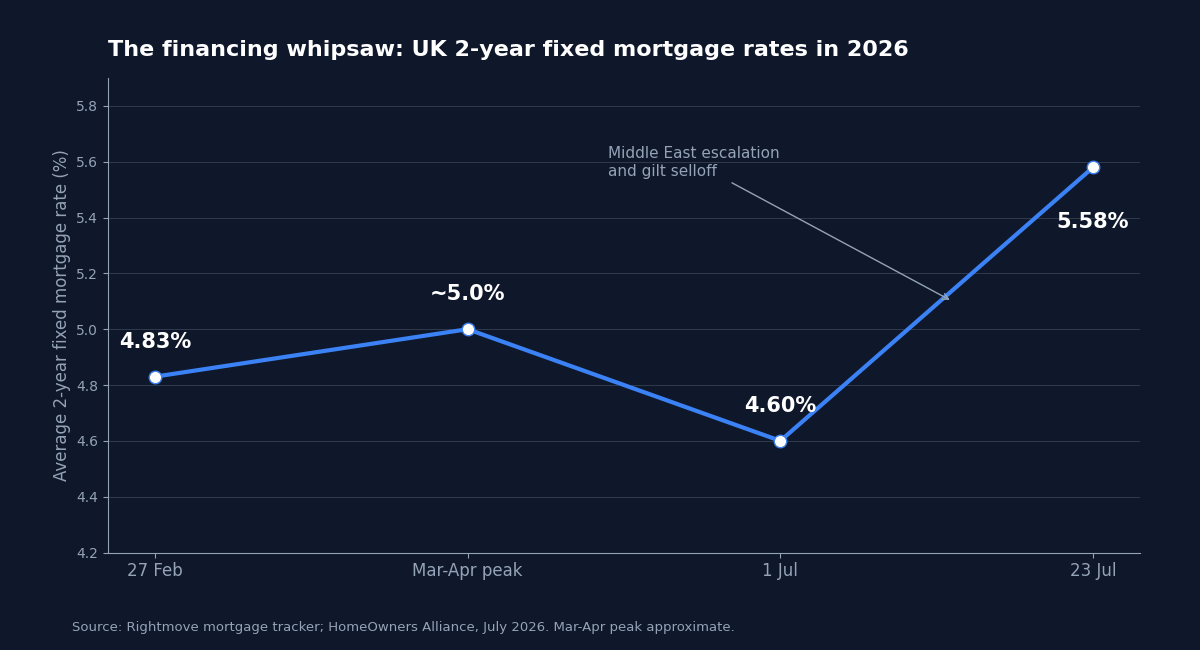
- Financing costs have whipsawed: the average two-year fixed mortgage rate has risen from 4.83 per cent in late February to 5.58 per cent by 23 July, unwinding June’s relief as the Gulf conflict pushed gilt yields above 5 per cent.
- Prices are stagnant, not falling: the average UK house price was flat at £277,484 in June after two months without growth, while Rightmove asking prices fell 1 per cent in the month to July; the Bank of England has held Bank Rate at 3.75 per cent all year.
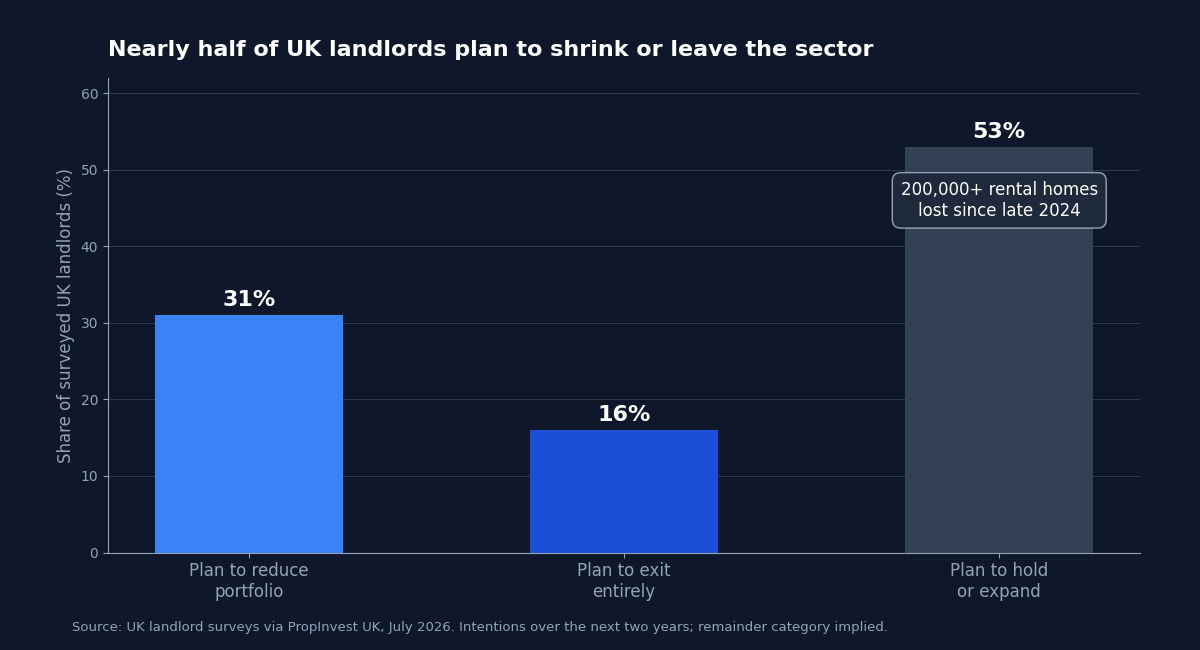
- The landlord exodus is structural: surveys suggest 31 per cent of landlords plan to shrink their portfolios and 16 per cent to exit entirely within two years, with more than 200,000 rental properties lost since late 2024, concentrated in London and the South.
- The investment map is being redrawn: direct buy-to-let economics deteriorate where yields are lowest, while housebuilders, contractors and REITs positioned for the construction push and rental professionalisation face a different, potentially more favourable, calculus.
UK property investment has absorbed rate shocks, tax changes and regulatory tightening in rolling waves since 2016. What is new in July 2026 is their convergence: a bond market pushing financing costs sharply higher just as a new Prime Minister arrives with the most interventionist housing agenda in decades. Andy Burnham’s premiership began on 20 July, three days after gilt yields above 5 per cent greeted the end of a month-long leadership transition, and his stated intentions, mass council housebuilding, tougher rental standards, property tax reform and an openness to rent controls, bear directly on every form of exposure to UK real estate. For investors, the question is not whether the sector reprices, but which parts carry the burden and which capture the spending.
The Agenda: What Burnham Has Actually Said
Separating stated policy from speculation matters, because the market will trade both. On the record: Burnham has pledged to build 100,000 new council homes a year, described by his team as the largest programme since the Second World War, and used his first Downing Street speech to promise an end to rough sleeping, with ministers planning to move long-term rough sleepers into secure housing, as the HomeOwners Alliance has catalogued. He has called for tougher standards in the private rented sector, and he has proposed reforming council tax and stamp duty, two levies with few defenders among economists of any stripe. Asked directly about rent freezes amid cost-of-living pressure, he replied that “We’re looking at all of those things”, which is not a commitment but is also not a denial.
In the speculative column sit reports that the property value threshold for the mansion tax could fall from £2 million to £1.5 million, which would pull a substantially larger share of London and South East housing stock into scope. Nothing has been announced; the first Burnham Budget this autumn is the vehicle to watch. His record as Greater Manchester mayor, landlord licensing schemes, a housing-first approach to homelessness and an activist stance on standards, is the best available guide to instincts, and those instincts run toward intervention.
The Rate Shock Hit UK Property Investment First
Policy risk is landing on a market already tightening financially. The average two-year fixed mortgage rate stood at 4.83 per cent on 27 February, climbed toward 5 per cent through the spring, fell back to 4.6 per cent by 1 July as inflation undershot and oil retreated, and has since snapped to 5.58 per cent as of 23 July, according to Rightmove’s tracker. The proximate cause sits in the gilt market: the renewed Middle East escalation drove long yields to and above 5 per cent, a move we examined in the bond market’s greeting for Prime Minister Burnham, and lenders repriced fixed-rate product within weeks. The Bank of England, which has held Bank Rate at 3.75 per cent since the start of the year, has been a spectator to a tightening delivered entirely by the curve.
The transmission into activity is visible. Mortgage approvals fell noticeably in May, consumer confidence and housing sentiment measures have weakened, and Savills’ July market update judges meaningful price growth unlikely over the short to medium term. The average UK house price was flat at £277,484 in June after a 0.6 per cent drop the month before, and asking prices fell 1 per cent in the month to July to £372,359. This is a market treading water: nominal prices holding, real prices eroding at the pace of inflation, and volumes thin.
The Landlord Exodus Meets a Landlord-Sceptic Government
The private rental sector was shrinking before Burnham arrived. Survey data compiled this month suggests 31 per cent of existing landlords plan to reduce their portfolios and 16 per cent intend to exit entirely within two years, with more than 200,000 rental properties lost since late 2024. The drivers are cumulative rather than singular: the Section 24 restriction of mortgage interest relief, the compliance load of the Renters’ Rights Act, EPC upgrade requirements, Making Tax Digital administration and the stamp duty surcharge on additional dwellings have compounded into the largest sustained withdrawal of small landlords in the modern history of the sector. The geography is uneven: exits concentrate in London and the South, where gross yields are lowest and mortgage costs bite hardest, while higher-yielding northern markets have proved stickier.
Into this, a government reviewing rent controls introduces a genuinely binary variable. The international evidence, from Berlin’s overturned Mietendeckel to Scotland’s 2022-24 cap, is that caps reliably compress in-tenancy rents while reducing supply and pushing advertised rents higher between tenancies; Scotland’s experience saw some of the fastest advertised rent growth in the UK during its cap period. A UK-wide control regime, even a loose one, would accelerate the exit of leveraged small landlords, transfer stock toward institutional operators and owner-occupiers, and, on the evidence, do little for the advertised rents new tenants face. Whether that trade is judged politically worthwhile is not an investment question; what it would do to the equity of a leveraged buy-to-let portfolio is.
| Indicator | Latest reading | Direction |
|---|---|---|
| Average house price (June) | £277,484 | Flat; second month without growth |
| Rightmove asking prices (July) | £372,359 | -1% month on month |
| Average 2-year fixed mortgage | 5.58% (23 July) | Up from 4.60% on 1 July |
| Bank Rate | 3.75% | On hold all year |
| 10-year gilt yield | Above 5% | Year-to-date highs |
| Rental stock since late 2024 | 200,000+ homes lost | Shrinking, concentrated in the South |
Who Builds 100,000 Council Homes a Year?
The construction pledge deserves to be taken seriously as an investment variable even if the target is missed, because the spending is real either way. England has not built 100,000 council homes in a year since the 1970s; recent annual social housebuilding across all tenures has run at a fraction of that. Reaching even half the target implies a multi-year expansion of public procurement that flows to contractors, materials suppliers, and housebuilders willing to partner on mixed-tenure schemes. The listed housebuilders enter this era with a complicated position: a council programme competes for land and labour and could cap private sale prices at the margin, but partnership revenue is counter-cyclical ballast in a flat private market. The construction supply chain, aggregates, bricks, modular specialists, is the cleaner expression of the spending, with fewer offsetting exposures to private demand.
The constraint is fiscal, and it is the same constraint the gilt market has been pricing all month. A government whose 10-year borrowing cost exceeds 5 per cent has less room for capital programmes than the one that drafted the manifesto, a tension we explored when Westminster’s transition began. If the autumn Budget funds the housing programme with additional issuance into this gilt market, the financing cost of the policy rises with every basis point, and the mortgage market imports the result. Housing policy and debt management are, for this government, the same subject.
Live Chart: FTSE 350 Real Estate (LSE: LAND)
Investor Implications
Direct residential. The buy-to-let calculus has moved decisively against small leveraged landlords in low-yield markets: a 5.58 per cent two-year fix against southern gross yields frequently below that level produces negative carry before voids and compliance costs, and the policy review adds an unpriceable tail. Higher-yielding northern markets retain positive carry and have seen the smallest increase in landlord sales, which is where the sector’s remaining private capital has been consolidating. Prime London faces the mansion tax speculation most directly; transaction volumes above £1.5 million may thin until the autumn Budget resolves the threshold question, a familiar pattern from past stamp duty episodes.
Listed property and housebuilders. UK REITs price policy and rates daily, unlike direct property, and the divergence within the sector is likely to widen: residential-exposed vehicles carry rent control risk, while beds-and-sheds strategies, logistics, student accommodation, build-to-rent at scale, stand on the other side of the small-landlord exodus, inheriting tenant demand that the shrinking private rental sector cannot house. Institutional build-to-rent is the structural winner of professionalisation if controls are avoided, and the structural casualty if they are not; the review is the sector’s single most important variable. Housebuilders trade the tension between partnership pipeline upside and private margin pressure; contractors and materials names are the less ambiguous route to the construction programme.
Cross-asset. The gilt market remains the master variable. Property in every form, mortgaged, listed or development-stage, is a duration asset funded off a curve that has spent July repricing for an oil shock, as we set out in UK gilt yields above 5 per cent. A Gulf de-escalation that retraces crude would ease mortgage rates faster than any housing policy could, while a further leg higher in yields would overwhelm the effect of every measure discussed in this piece. Sterling investors weighing the sector may wish to treat the autumn Budget and the rent control review as the two dated catalysts, and the gilt curve as the continuous one.
| Policy lever | Relative beneficiaries | Under pressure |
|---|---|---|
| 100,000 council homes a year | Contractors, materials suppliers, partnership housebuilders | Private-sale margins where land and labour compete |
| Rent controls (if adopted) | Owner-occupier demand; sitting tenants | Leveraged buy-to-let; build-to-rent valuations |
| Tougher rental standards | Institutional operators built for compliance | Small landlords with older stock |
| Council tax and stamp duty reform | Transaction volumes if duties fall | Prime London if the mansion tax threshold drops |
What to Watch
- Autumn 2026: the first Burnham Budget: the mansion tax threshold, stamp duty and council tax reform detail, and the funding route for the council housing programme.
- 6 August 2026: the Bank of England’s MPC decision and updated forecasts, the first under the new government and with the oil shock in the projections.
- Second half 2026: the outcome of the rent control review; any formal consultation document would move residential landlord and build-to-rent assets immediately.
- Monthly: mortgage approvals and the Rightmove/Halifax price series, for evidence of whether the July rate snap-back feeds through into autumn transaction volumes.
Conclusion
The UK property market that Prime Minister Burnham inherits is not in crisis; it is in stasis, with flat prices, thin volumes and a financing cost that the gilt market has just pushed sharply higher. His agenda would break the stasis deliberately: build at scale, professionalise the rental sector, tax property differently. Some of that is funded ambition and some is instinct awaiting a Budget, and the distinction will only resolve in the autumn. For investors the honest summary is that the era of undifferentiated UK property exposure is over. The same policy package that impairs a leveraged southern buy-to-let portfolio funds a construction supply chain and clears the field for institutional landlords. The exposure now needs to be considered segment by segment; the Budget and the rent control review are the dated events, and the gilt curve, not the housing headlines, remains the variable that prices all of it.
Frequently Asked Questions
What are Andy Burnham’s housing policies as Prime Minister?
His stated commitments include building 100,000 council homes a year, described as the biggest programme since the Second World War, ending rough sleeping, imposing tougher standards on the private rented sector, and reforming council tax and stamp duty. Rent controls are under review but not announced, and reports of a lower mansion tax threshold remain speculation ahead of the autumn Budget.
Will the UK introduce rent controls in 2026?
No decision has been made. Asked about rent freezes, Burnham said “We’re looking at all of those things”. International evidence, including Scotland’s 2022-24 cap, suggests controls hold down in-tenancy rents but reduce rental supply and push up advertised rents between tenancies, which is why the review is the single most watched variable for residential landlords and build-to-rent investors.
Why are UK mortgage rates rising again in July 2026?
The renewed Middle East conflict pushed oil sharply higher and drove gilt yields to year-to-date highs above 5 per cent, and lenders repriced fixed-rate mortgages accordingly. The average two-year fix rose from 4.60 per cent on 1 July to 5.58 per cent by 23 July, despite the Bank of England holding Bank Rate at 3.75 per cent all year.
Is buy-to-let still worth it in the UK?
The economics have split by geography. In much of London and the South, gross yields below current mortgage rates mean negative carry for leveraged landlords, which is where portfolio sales are concentrated. Higher-yielding northern markets retain positive carry and have seen far fewer exits. Policy risk from the rent control review and rental standards applies everywhere and is not yet quantifiable.
Sources: HomeOwners Alliance, Andy Burnham’s potential policies; Property Portfolio Investor, UK rent controls under review; Rightmove, current UK mortgage rates; Savills, UK housing market update July 2026; Bloomberg, UK house prices flat in June; PropInvest UK, why landlords are exiting buy-to-let; Bank of England.
Related Reading: The gilt market backdrop is covered in UK gilt yields above 5 per cent as the bond market greets Prime Minister Burnham and the gilt market’s pricing of Westminster’s transition. The oil shock driving the July repricing is examined in the war-risk repricing of the Strait of Hormuz, and the European rate backdrop in the ECB’s hawkish hold. For the fundamentals, start with what a rate rise actually changes. For the rate decision that followed, see the Bank of England’s dovish July hold. For the wider economic backdrop, see UK Q2 GDP growth and the quarter business services won. See also how REITs work.

Leave a Reply