

Khan Capitals | June 2026
Key Takeaways
- NVIDIA and SK hynix have formalised a multiyear technology partnership. Announced on 7 June 2026, the agreement aligns SK hynix’s capacity and product roadmap with NVIDIA’s AI infrastructure roadmap, covering memory codevelopment for Vera Rubin AI supercomputers, Vera CPUs, RTX Spark-powered PCs and Jetson Thor robotics. No financial terms, duration or volume were disclosed.
- Memory has become the strategic bottleneck of the AI build-out. DRAM contract prices rose roughly 90 to 95 per cent quarter on quarter in the first quarter of 2026 and a further 58 to 63 per cent in the second, with high-bandwidth memory capacity for the year effectively sold out.
- The deal marks a shift from spot procurement to vertical pre-commitment. Reserving a supplier’s roadmap and capacity years in advance is becoming the operating model of the semiconductor supply chain, mirroring the prepayment structures now visible across the AI complex.
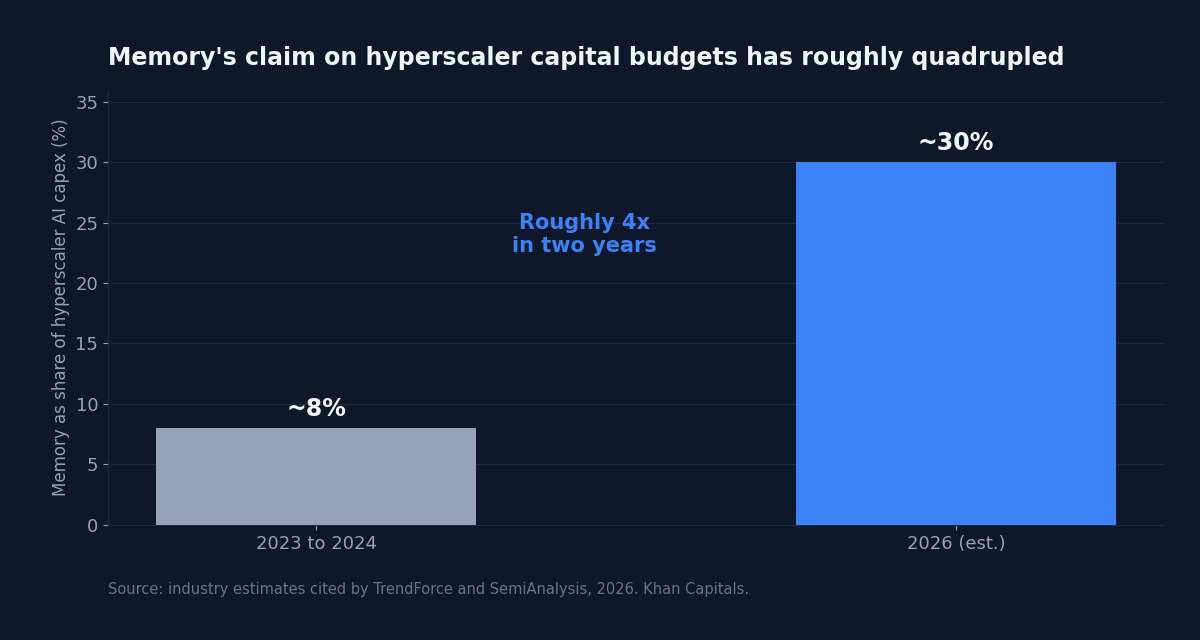
- Rising memory costs are migrating into system prices and hyperscaler budgets. Memory is projected to absorb around 30 per cent of hyperscaler capital expenditure in 2026, up from roughly 8 per cent in 2023 to 2024, lifting the bill of materials for every AI server.
- The competitive response is a capacity race. SK hynix intends to roughly double memory wafer capacity over five years, Samsung is racing to qualify HBM4 and expand output, and Micron is ramping its own HBM4 line, yet most forecasters still see the shortage persisting into 2027 and beyond.
Part of: The AI Infrastructure Supercycle — Khan Capital’s hub on the AI infrastructure build-out.
The NVIDIA SK hynix Memory Deal: A Partnership Built Around Scarcity
The NVIDIA SK hynix memory deal announced on 7 June 2026 reads, at first glance, like a routine deepening of a supplier relationship that has existed for years. SK hynix has been NVIDIA’s principal source of high-bandwidth memory through successive accelerator generations, and the two companies have co-engineered the memory stacks that sit at the heart of the world’s most advanced AI computing platforms. What makes this announcement different is not the existence of the collaboration but its formalisation as a multiyear strategic commitment, and the context in which it arrives: a memory market in the grip of the most acute shortage in over a decade.
The substance of the agreement is broad. SK hynix will codevelop next-generation memory aligned to NVIDIA’s infrastructure roadmap, spanning the Vera Rubin AI supercomputers, Vera CPUs, RTX Spark-powered PCs and Jetson Thor robotic computing platforms. The two will also apply NVIDIA’s own software to the manufacture of memory itself: SK hynix is using the CUDA-X libraries and the PhysicsNeMo framework to accelerate semiconductor simulation, technology computer-aided design and computational lithography, and is building fab digital twins using NVIDIA Omniverse, OpenUSD pipelines and the cuOpt optimisation engine to move towards autonomous fab operations. The framing is telling. This is not a purchase order; it is an attempt to lock a supplier’s roadmap, capacity and even its manufacturing methods into the buyer’s own development cycle.
Crucially, the companies disclosed no financial terms, no contract duration and no committed volumes. For a partnership of this strategic weight, the absence of numbers is itself the signal. The value being exchanged is not a price; it is priority. In a market where capacity is the binding constraint, a guaranteed claim on a leading supplier’s future output is worth more than any single quarter’s discount.
The Memory Supercycle in Numbers
To understand why a memory partnership now commands the attention usually reserved for accelerator launches, the pricing backdrop has to be set out plainly. The memory market has moved from oversupply to severe scarcity in the space of a year. According to TrendForce, DRAM contract prices rose by a record 90 to 95 per cent quarter on quarter in the first quarter of 2026, then climbed a further 58 to 63 per cent in the second quarter. NAND flash contract prices have risen on a similar trajectory, up an estimated 70 to 75 per cent in the second quarter. These are not the gentle cyclical moves the memory industry is known for; they are step changes of a magnitude rarely seen outside genuine supply crises.

The driver is the reallocation of advanced wafer capacity toward high-bandwidth memory, the stacked DRAM that feeds AI accelerators. HBM commands premium pricing and consumes a disproportionate share of leading-edge capacity, so every wafer diverted to it tightens the supply of conventional DRAM and NAND. The result is a supply-demand gap that TrendForce and others describe as the widest since 2011. HBM capacity for 2026 is, in practical terms, already sold out, with manufacturers reportedly declining new orders. The table below sets out the sequence.
| Segment | Q1 2026 QoQ | Q2 2026 QoQ | Supply backdrop |
|---|---|---|---|
| DRAM (contract) | +90 to 95% | +58 to 63% | Capacity diverted to HBM; deficit widest since 2011 |
| NAND flash (contract) | Sharp rise | +70 to 75% | AI server and enterprise SSD demand tightening supply |
| HBM (AI memory) | Premium tier | Sold out for 2026 | HBM4 at roughly mid-$500 per stack, over double HBM3E |
The supplier economics confirm the picture. SK hynix reported record first-quarter revenue of 52.6 trillion won, up around 60 per cent on the prior quarter and close to 200 per cent year on year, with operating profitability at levels the memory industry has historically only dreamed of during its best cycles. The boom is not speculative; it is being banked.
Why Memory Became the Bottleneck
For most of the AI build-out the narrative has centred on the accelerator. The graphics processing unit was the scarce object, the component that allocated itself to the highest bidder, and the lens through which investors read the entire trade. That framing is now incomplete. An accelerator is only as useful as the memory bandwidth feeding it, and the modern AI training workload is, to a first approximation, a memory-bandwidth problem dressed as a compute problem. Each new accelerator generation demands more HBM stacks, higher stack counts and faster interfaces, and the manufacturing complexity of that memory has risen faster than the industry’s ability to add capacity.
This is why the bottleneck has migrated down the stack. HBM is fabricated on leading-edge DRAM processes, then stacked, bonded and tested in steps that yield imperfectly and consume capacity that might otherwise produce several times the volume of conventional memory. As the hyperscalers and model developers raced to secure accelerators, they implicitly bid for the memory inside them, and the memory makers found themselves unable to satisfy both the AI premium tier and the broader market at once. The conventional DRAM and NAND that price the cost of a laptop, a smartphone or an enterprise server became collateral casualties of a supply chain optimising for AI.
NVIDIA’s own management has been candid that this is not a passing squeeze. At Computex in early June, with SK hynix announcing a plan to roughly double its memory wafer capacity over five years, Jensen Huang reportedly underlined the demand picture in blunt terms. The message from both sides was consistent: the shortage is structural, the lead times for new capacity are measured in years, and the only way to guarantee supply is to commit to it early. The partnership is the logical conclusion of that view.
From Spot Buying to Pre-Commitment: A New Supply-Chain Model
The most consequential feature of the NVIDIA SK hynix memory deal is not the memory itself but the model of procurement it represents. The semiconductor supply chain has historically run on a blend of long-term agreements and spot purchasing, with buyers retaining the flexibility to switch suppliers and renegotiate as cycles turned. That flexibility was an asset in a world of periodic oversupply. In a world of structural scarcity, it becomes a liability, because the supplier, not the buyer, holds the pricing power, and capacity unreserved is capacity lost to a competitor.
The response across the AI complex has been a shift toward vertical pre-commitment: reserving a supplier’s roadmap and output years ahead, sometimes prepaying for it, sometimes co-investing in the capacity itself. This is the same logic visible in the cloud operators’ contracts, where customers prepay for the chips that will populate data centres not yet built, a pattern examined in our analysis of Oracle’s $638 billion cloud backlog. It is visible one rung up the stack in Dell’s record AI server backlog, where demand is booked long before it is built. The memory partnership extends the same principle to the most upstream input of all. The AI supply chain is reorganising itself around the assumption that scarcity, not abundance, is the steady state.
For NVIDIA the strategic calculus is clear. Securing a privileged claim on SK hynix’s memory roadmap protects the cadence of its own product launches, insulates it from the price spikes hitting the merchant market, and raises the barrier for any rival accelerator designer hoping to source comparable memory at comparable terms. Industry reporting suggests NVIDIA already secures preferential memory pricing well below the rates paid by hyperscalers and the broader market, a structural advantage that compounds as prices rise. The partnership institutionalises that edge.
What Surging Memory Prices Mean for System Costs and Capex
The pricing surge does not stay contained within the memory makers’ income statements. It flows directly into the cost of every system that depends on memory, and nowhere more visibly than in the AI server. Memory is now projected to account for roughly 30 per cent of hyperscaler capital expenditure in 2026, up from around 8 per cent in the 2023 to 2024 period, a near-quadrupling of memory’s claim on the budget in the space of two years. When the single largest non-compute line item in a data centre rises at this pace, it reshapes the economics of the entire build.
The mechanical consequence is rising system prices. Analysts tracking the bill of materials for flagship accelerators have flagged that higher memory costs alone could lift the price of a top-tier AI server meaningfully through the year. For the hyperscalers, this lands at a moment when total capital expenditure is already running at extraordinary levels, with the combined budgets of the largest cloud operators heading toward three-quarters of a trillion dollars, a scale we examined in our coverage of the $725 billion hyperscaler capex cycle. Rising memory prices mean that even a flat unit build-out costs more, and that a given budget buys less compute than it did a year earlier. The deflationary assumption that underpinned much of the AI investment case, that the cost per unit of intelligence falls relentlessly, now has a powerful offsetting force running through the memory line.
There is a distributional dimension too. Buyers with privileged supply agreements, NVIDIA foremost among them, absorb the increase on better terms than those without. Accelerator designers and system builders reliant on the merchant market face the full force of the price moves, a divergence that widens the competitive gap between the supply-secured and the supply-exposed. In a scarcity market, the procurement contract becomes as much a source of advantage as the product design.
The Competitive Response: Samsung and Micron
A partnership that ties NVIDIA more tightly to SK hynix inevitably reshapes the calculus for the other two members of the memory oligopoly. Samsung, having ceded early HBM leadership, has been racing to qualify its HBM4 for NVIDIA and is reported to be nearing agreement to supply a meaningful share of NVIDIA’s 2026 HBM4 requirement, while planning a substantial increase in HBM capacity over the year. Micron, the third major supplier, is ramping its own HBM4 toward mass production in 2026. None of the three is standing still; all are pouring capital into leading-edge expansion.
Yet the structure of the market gives the incumbent supplier a durable edge. HBM pricing for the latest generation is reported to sit in the mid-$500 range per stack, more than double the previous generation, and qualification cycles are long and demanding. A formalised roadmap partnership of the kind NVIDIA has struck with SK hynix raises the bar for rivals not only on price but on integration: codeveloping memory to a buyer’s specification, and embedding the buyer’s software into the fab, creates switching costs that a simple supply contract does not. Samsung and Micron will compete hard for allocation, and NVIDIA has every incentive to maintain multiple qualified suppliers, but the partnership tilts the field.
The capacity race itself carries the seeds of the next cycle. Memory is famously prone to overbuild: capacity commitments made at the peak of a shortage tend to arrive together, and the industry’s history is one of feast followed by glut. SK hynix’s plan to double wafer capacity, Samsung’s expansion and Micron’s ramp will eventually add very large volumes of supply. The open question is timing. Most forecasters expect the shortage to persist through 2027 and possibly beyond, with some industry voices pointing to little relief before 2028, and SK hynix’s own leadership suggesting the demand imbalance could run for years longer still. The risk for investors is not that the capacity never arrives, but that it arrives all at once.
Live Chart: NVIDIA
What the Market Is Underappreciating
Two aspects of this development are not yet fully reflected in how the AI trade is priced. The first is the degree to which memory has become a gating input rather than a commodity component. Markets have grown accustomed to treating memory as the cyclical, low-margin tail of the semiconductor industry, a business to be valued on through-cycle averages and mean reversion. The current cycle is different in character because the demand is being driven by a structural build-out rather than a consumer refresh, and because the scarce sub-component, HBM, sits on the critical path of every AI accelerator. A memory shortage is now, functionally, an AI compute shortage. That reframing has implications for how the durability of memory pricing should be assessed, and for how much of the AI capex story is actually a memory story in disguise.
The second underappreciated element is the strategic value of pre-commitment relative to its accounting invisibility. Because the partnership carries no disclosed financial terms, it does not register as a transaction on any balance sheet, yet it may prove more valuable than many deals that do. A guaranteed claim on the scarcest input in the supply chain is an option on continued growth that competitors cannot easily replicate. The market can price a reported contract; it struggles to price a reserved roadmap. As more of the AI supply chain reorganises around these pre-commitment structures, conventional financial statements will capture less and less of where the real advantage sits. Investors who read only the reported numbers risk missing the architecture being built around them.
Investor Implications
Equities
The memory makers are the most direct beneficiaries of the supercycle, and their record profitability reflects it, but the cyclicality of the sector argues for attention to the timing of new capacity rather than extrapolation of current margins. For the accelerator designers, the partnership reinforces the case that supply security has become a competitive moat in its own right; the names with privileged memory access are better insulated than those exposed to the merchant market. Investors weighing the broader AI complex may wish to consider that rising memory costs compress the economics of system builders and accelerator challengers even as they enrich the suppliers, a divergence that the recent repricing of AI semiconductor exposure began to expose. The equity question is no longer simply who has the best chip, but who has secured the inputs to build it.
Fixed Income
The capacity race is intensely capital-intensive, and the memory makers and hyperscalers funding it are becoming larger and more frequent issuers. Doubling wafer capacity, building new fabs and pre-funding multi-year supply all draw on debt and equity markets at scale. For credit investors, the relevant questions are the trajectory of issuance from the memory names, the direction of spreads on the capital-goods and semiconductor cohort, and the sensitivity of these balance sheets to a turn in the memory cycle. A sector funding a peak-cycle expansion carries refinancing and leverage risk that is easy to overlook while profits are at records. Rising system costs also feed the inflation impulse in technology hardware, a marginal consideration for the rates path that sits alongside the larger macro drivers.
Cross-Asset
At the cross-asset level, the memory bottleneck is a reminder that the AI trade rests on a physical supply chain with hard constraints, and that those constraints introduce a source of volatility distinct from the demand narrative. The same record results that gladden the memory makers tighten the budgets of their customers, and the interplay between the two sides determines how much of the build-out actually gets built. The episode reinforces a theme running through markets in 2026: capital intensity and supply security have become the swing variables in how the AI complex is priced, displacing the simpler demand-led story of the prior two years. Positioning that treats AI as a uniform trade understates the divergence now opening between the supply-secured and the supply-exposed, and between the segments of the chain that capture the scarcity premium and those that pay it.
What to Watch
- Capacity versus shortage (through 2027 to 2028): whether SK hynix’s wafer-capacity doubling and the Samsung and Micron HBM4 ramps arrive gradually or together, which would risk a glut.
- HBM4 pricing: the direction of high-bandwidth memory contract prices from the current mid-500-dollar-per-stack level.
- Memory’s share of hyperscaler capex: whether it climbs beyond the roughly 30 per cent expected in 2026 and squeezes compute bought per dollar.
- Samsung’s qualification: how much of NVIDIA’s 2026 HBM4 requirement Samsung ends up supplying alongside SK hynix.
- Memory-maker balance sheets: issuance and credit spreads across the memory and capital-goods cohort funding the capacity race.
Conclusion
The NVIDIA SK hynix memory deal is a small announcement with a large meaning. On its face it is a deepening of a long-standing supplier relationship, light on disclosed detail and easy to overlook amid the steady cadence of AI infrastructure news. Read in context, it is a statement about the new physics of the AI build-out: memory, not compute alone, is the binding constraint, and securing it has become a strategic act rather than a procurement routine. The partnership formalises a privileged claim on the scarcest input in the chain, and in doing so it sets a template that the rest of the industry is already following.
For markets, the signal worth tracking from here is the cadence of capacity additions against the persistence of the shortage. If demand continues to outrun supply through 2027 as most forecasters expect, the memory makers will keep banking record profits and the pre-commitment model will spread further up and down the chain. If the wave of new capacity arrives together, the cycle will turn with the speed the memory industry is known for. Either way, the lesson of June 2026 is that the AI trade can no longer be understood through the accelerator alone. The memory that feeds it has moved to the centre of the story, and the contracts that reserve it have become as consequential as the chips themselves. This article is analysis, not investment advice.
Frequently Asked Questions
What did NVIDIA and SK hynix actually agree?
They announced a multiyear strategic technology partnership on 7 June 2026 that aligns SK hynix’s capacity and product roadmap with NVIDIA’s AI infrastructure roadmap, spanning the Vera Rubin supercomputers, Vera CPUs, RTX Spark PCs and Jetson Thor robotics. No financial terms, duration or volumes were disclosed, because the value being exchanged is priority of supply rather than price.
Why is computer memory in such short supply in 2026?
Advanced wafer capacity is being reallocated to high-bandwidth memory for AI accelerators, which starves conventional DRAM and NAND. DRAM contract prices rose about 90 to 95 per cent in the first quarter of 2026 and a further 58 to 63 per cent in the second, and high-bandwidth memory for the year is effectively sold out, leaving the supply deficit the widest since 2011.
How does the memory shortage affect AI server costs?
Memory is now projected to absorb around 30 per cent of hyperscaler capital expenditure in 2026, up from roughly 8 per cent in 2023 to 2024, which lifts the bill of materials for every AI server. A given budget therefore buys less compute than a year earlier, and buyers with privileged supply deals, NVIDIA among them, absorb the increase on better terms than those reliant on the open market.
Will the memory shortage ease soon?
SK hynix plans to roughly double wafer capacity over five years, while Samsung and Micron are ramping their own HBM4 lines. Even so, most forecasters expect the shortage to persist through 2027 and possibly into 2028. The main risk for investors is not that new capacity never arrives, but that it arrives all at once and tips the market back into glut.
Sources: NVIDIA Newsroom: NVIDIA and SK hynix Announce Multiyear Technology Partnership, 7 June 2026; SK hynix Newsroom: Multi-year Technology Partnership with NVIDIA; TrendForce: Samsung, SK hynix plan HBM price hike for 2026; Tom’s Hardware: DRAM and NAND contract prices to climb again in Q2; Tom’s Hardware: SK hynix to double memory wafer capacity over five years; CNBC: SK hynix posts record first-quarter results; Tom’s Hardware: Memory to consume 30% of hyperscaler spending. Figures as reported through June 2026.
The Khan Capital Brief
Understand what moves markets
Analysis like this, free in your inbox. No spam, unsubscribe any time.
Related Reading: The memory partnership is the upstream chapter of a story Khan Capitals has tracked across the AI complex. For the scale of the spending driving memory demand, see AI Capex Hits $725bn: Wall Street Splits on the Hyperscaler Trade. For the moment a record AI result still failed to satisfy the market, read Nvidia’s $91 Billion Quarter: When the Bar Becomes the Beat. The build-out economics moving down the hardware stack are examined in Dell’s $51.3 Billion AI Server Backlog, the cloud operators’ prepayment model in Oracle’s $638 Billion Cloud Backlog, and the violent repricing of AI exposure in The $1 Trillion AI Semiconductor Selloff. For the broader memory-supply story behind these moves, see Micron’s record quarter and the AI memory supercycle. The consumer-facing consequences of the memory squeeze are examined in the AI memory price shock. The moment the supply premise cracked, when Meta moved to sell its excess compute, is analysed in Meta’s AI Cloud Pivot. For the fundamentals, start with high-bandwidth memory, explained. For the foundry capacity that HBM ultimately attaches to, see TSMC’s Q2 2026 earnings. The story culminated in SK Hynix’s record $26.5bn Nasdaq listing. On the policy front, see the start of licensed H200 shipments to China.

Leave a Reply