
Khan Capitals | July 2026
Key Takeaways
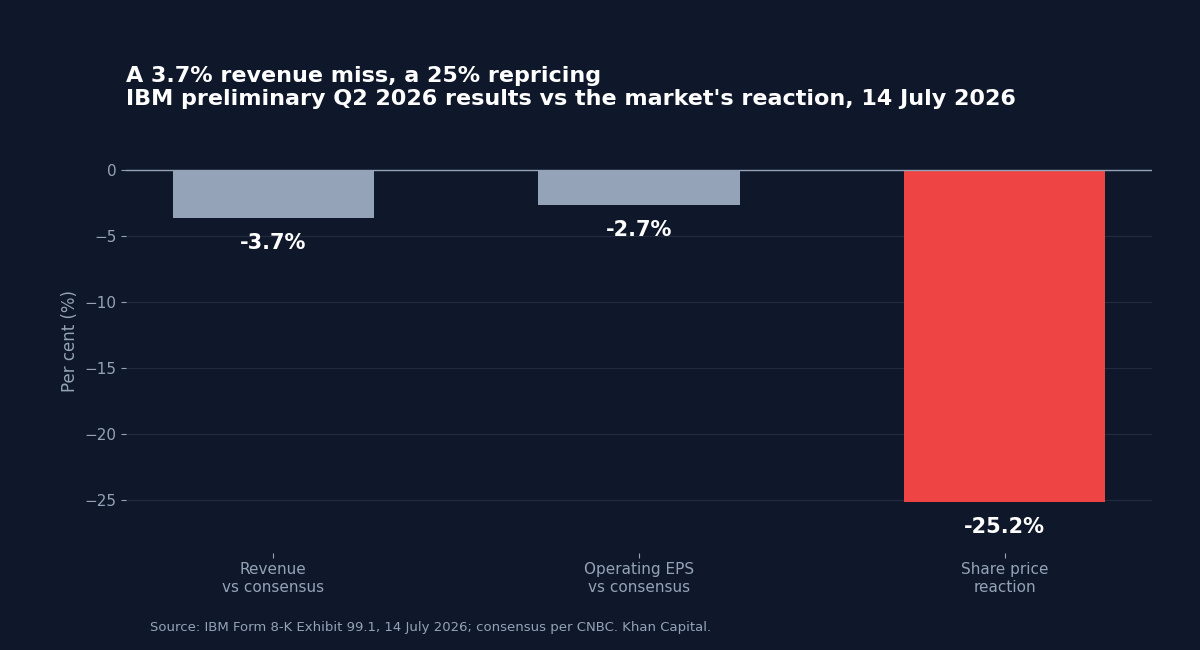
- A 3.7 per cent revenue miss produced a 25 per cent repricing. IBM pre-announced second-quarter revenue of $17.2 billion against a consensus near $17.86 billion. The shares closed 25.21 per cent lower at $217.07, the worst single session in the company’s listed history, erasing roughly $68 billion of market value.
- Operating earnings actually grew. Operating earnings per share of $2.93 were up 5 per cent year on year and operating pre-tax margin expanded 30 basis points to 19.2 per cent. The damage was concentrated in the revenue line, not the profit line.
- The stated cause was budget reallocation, not lost demand. Arvind Krishna said clients shifted late-June capital spending toward servers, storage and memory to secure supply-constrained infrastructure ahead of price rises, and that numerous large deals failed to close on the timelines IBM expected.
- The mainframe cycle is not the problem. z17 remains at nearly 130 per cent programme-to-programme against z16, itself IBM’s strongest ever, with clients representing 85 per cent of installed capacity holding or growing it.
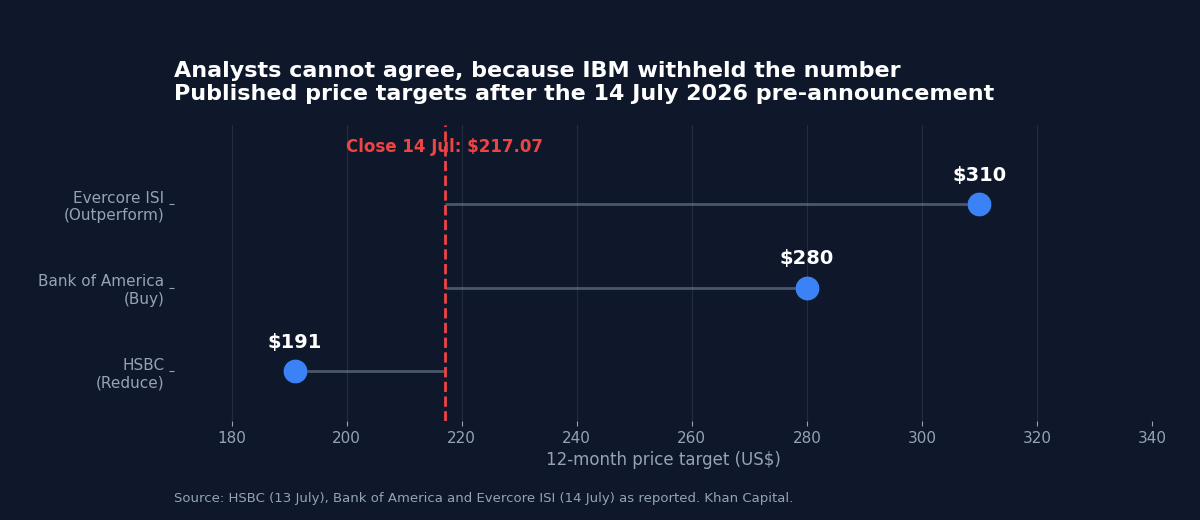
- IBM declined to update its full-year outlook, deferring it to the scheduled 22 July call and leaving the market eight days to guess whether the missing revenue was delayed, reduced or gone. Sell-side targets now span $191 to $310.
Part of: The AI Infrastructure Supercycle — Khan Capital’s hub on the AI infrastructure build-out.
A Letter, Not a Quarter
The first thing to understand about IBM’s Tuesday is that it was not an earnings report. IBM does not report second-quarter results until 22 July. What arrived on the morning of 14 July was an unscheduled letter from the chairman and chief executive, Arvind Krishna, releasing what the company carefully called “selected preliminary” figures, with the caveat that the books were not closed and the final numbers “could be slightly different”.
Companies do not write letters like that for good news. The mechanism itself carries information: a pre-announcement means management has concluded that the gap between expectation and delivery is too wide to sit on until the scheduled date. The market read the envelope before it read the contents, and the result was the worst day IBM has had since data on its share price begins.
What makes the episode worth more than a paragraph in a market wrap is the distance between the size of the operational shortfall and the size of the reaction to it. This was not a company that lost a franchise or discovered a hole in its accounts. On the numbers IBM disclosed, it came in about 3.7 per cent light on revenue and grew its operating earnings. The equity market treated it as something categorically worse.
IBM’s Worst Day on Record, in Proportion
IBM’s worst day on record deserves to be measured against its own history rather than the adjectives it attracted. The shares fell 25.21 per cent to close at $217.07, taking roughly $68 billion off a market capitalisation that ended the session just under $205 billion. The previous record was Black Monday, 19 October 1987, when IBM fell about 23.7 per cent as the American equity market came apart around it. Tuesday’s fall was larger, and came on a day when the S&P 500 was calm and the Dow was being held up by a record quarter from Goldman Sachs.
That comparison is the point. In 1987 IBM fell because everything fell. In 2026 IBM fell alone, on company-specific news, by more. For a business with $17 billion of quarterly revenue and operating margins that expanded in the very quarter being punished, a one-day repricing of that magnitude is not a considered revision of intrinsic value. It is a market discovering that it does not know something it thought it knew, and marking down the uncertainty rather than the cash flows.
The arithmetic of the asymmetry is worth stating plainly. Revenue missed consensus by roughly $660 million, or 3.7 per cent. Operating earnings per share missed by eight cents, or 2.7 per cent. The equity lost a quarter of its value. Something other than the quarter was being repriced.
Where the Money Actually Went
Krishna’s explanation has been widely quoted and thinly read. The relevant passage: “In the last few weeks of June, we saw clients shift their quarterly capex spend toward servers, storage, and memory purchases to secure supply-constrained infrastructure ahead of expected price increases. This dynamic impacted client buying patterns. While we anticipated some supply chain related impact in our expectations, we did not anticipate the magnitude of the capex reprioritization.”
Read that with an eye to what it says about the wider market rather than about IBM. It describes customers who, facing scarcity and rising prices in memory and servers, spent their available budget locking in hardware, and funded that by not spending on software and services in the same window. The budget did not grow. It moved.
This is the mechanism Khan Capital described a fortnight ago in the AI memory price shock, arriving in an incumbent’s income statement for the first time. When we wrote that Apple and Microsoft were passing memory costs on to consumers, the transmission channel was pricing. IBM has now documented a second and less visible channel: inside a corporate IT budget that is fixed over any given quarter, an increase in the cost and scarcity of hardware is funded by a decrease in everything else. The AI build-out is not only adding demand for chips. It is quietly taking money away from the software and consulting lines of every vendor that shares a customer with a memory supplier.
That is the part of Tuesday the market got right, even if it reached the conclusion by the wrong route. Where the reasoning went wrong was in treating a timing effect as a permanent one. A pull-forward of hardware purchases into late June is a borrowing of demand from the future and a suppression of concurrent software spend. It reverses when scarcity eases. Whether it eases is now the question, and it is a question about memory supply, not about IBM.
Krishna added a second cause that received almost no coverage: clients were “distracted with rapidly-evolving, industry-wide cybersecurity concerns in the quarter”. And a third, the one that ought to worry shareholders most because it is the only one that is IBM’s own fault: “These conditions require our teams to execute perfectly, and this quarter we faltered. We did not adapt and move quickly enough, and numerous large deals failed to close on the timelines we expected, driving the majority of our shortfall.”
The majority of the shortfall, on management’s own account, was deal timing. Not lost demand, not competitive displacement, not AI eating the software stack. Deals that did not close when IBM said they would.
What the Segments Say
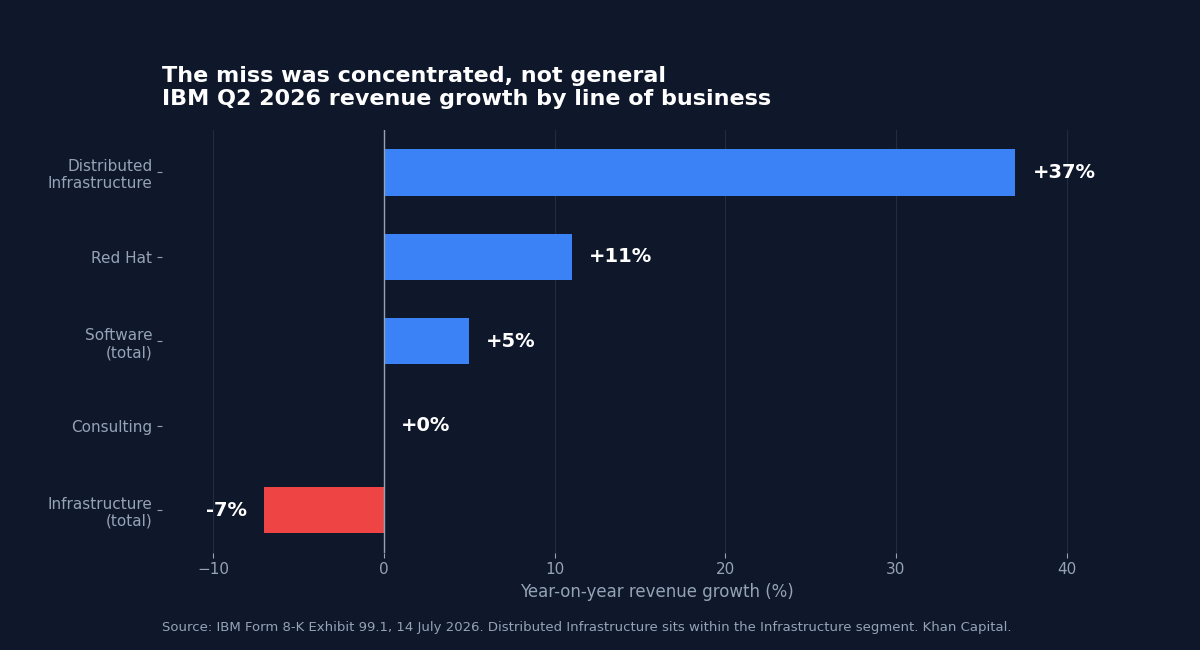
The segment detail complicates the tidy narrative. Software grew 5 per cent, with Red Hat accelerating sequentially to 11 per cent and the HashiCorp and Confluent acquisitions both described as performing strongly. Consulting was flat as reported, up 1 per cent at constant currency, with signings growth led by generative AI work. Infrastructure fell 7 per cent.
But inside Infrastructure sits the fact that most contradicts the headline. Distributed Infrastructure, the part of IBM that sells the servers and storage clients were scrambling to secure, had its best quarter in IBM’s reported history, up 37 per cent, with strong growth in Power and Storage and roughly $500 million of backlog leaving the quarter. IBM was not bypassed by the hardware rush. It sold into it. The rush simply cannibalised higher-margin revenue elsewhere in the same building, and the mix shift did the damage.
| Metric | Q2 2026 | Q2 2025 | Change |
|---|---|---|---|
| Revenue | $17.2bn | $17.0bn | +1% |
| Software revenue | n/d | n/d | +5% |
| Consulting revenue | n/d | n/d | Flat (+1% cc) |
| Infrastructure revenue | n/d | n/d | -7% |
| Gross profit | $9,907m | $9,977m | -0.7% |
| Gross margin (GAAP) | 57.7% | 58.8% | -100bps |
| Operating gross margin | 59.4% | 60.1% | -70bps |
| Operating pre-tax margin | 19.2% | 18.8% | +30bps |
| Diluted EPS (GAAP) | $2.27 | $2.31 | -2% |
| Operating EPS (non-GAAP) | $2.93 | $2.80 | +5% |
| Free cash flow (6M) | $4.76bn | n/d | n/d |
The profit picture in that table is why the reaction looks disproportionate. Operating pre-tax margin expanded, operating earnings per share rose 5 per cent, and first-half free cash flow reached $4.76 billion. A company genuinely disintermediated by artificial intelligence would not look like this in the quarter it happened.
The Mainframe Is Not the Problem
Much of Tuesday’s commentary reached for the oldest story in technology: the mainframe is finally dying, and artificial intelligence killed it. The letter says the opposite, in terms difficult to misread.
IBM told investors in April that it expected Infrastructure revenue to decline in the low single digits for the year, beginning in exactly this quarter, because z17 was wrapping on its launch. Mainframe revenue is cyclical by construction: a new generation ships, the installed base upgrades over several quarters, revenue peaks and falls back until the next generation. A decline was the plan. The shortfall was that it was steeper than planned.
And the programme itself is performing extraordinarily. z17 is running at nearly 130 per cent programme-to-programme against z16, itself the strongest mainframe programme in IBM’s history, and clients representing 85 per cent of installed MIPS are maintaining or growing capacity. A dying product line does not produce those figures. What produced the miss was that the Z shortfall dragged the associated software stack down with it, primarily in Transaction Processing, because that software attaches to the hardware. The hardware slipped a quarter and the high-margin software slipped with it. That is a timing relationship, not a structural one.
The Number IBM Did Not Give
Here is the decision that, in our reading, cost IBM most of the 25 per cent. Having pre-announced a revenue miss and explained it as budget reallocation plus deals that slipped, IBM did not reaffirm, revise or withdraw its full-year revenue and free cash flow outlook. It said it would “discuss our full-year expectations” on the 22 July call.
Consider what that leaves an investor holding. Management has said the majority of the shortfall was deals that failed to close on expected timelines. It has pointedly not said whether those deals closed in July, will close in the second half, or have gone away. It has said clients reprioritised capital expenditure toward hardware, but not whether that has continued into the current quarter. The single question that determines whether this is a one-quarter timing wobble or the first quarter of a structural transfer of enterprise budget away from software has been deferred for eight days.
Markets cannot hold that question open. They price it, and in the absence of a number they price the distribution, applying whichever narrative is most available. The most available narrative in July 2026 is that artificial intelligence is redrawing the enterprise technology map, and so that is the narrative that got applied, to the full width of its tail.
The dispersion in sell-side targets is the clearest evidence that this was an information problem rather than a valuation one. HSBC’s Abhishek Shukla had downgraded IBM to Reduce the previous day on valuation grounds, cutting his target to $191 and arguing that a “synthetic IBM” assembled from SAP, Accenture, HP and IonQ could be bought for $287.56, roughly the price of an IBM share at the time. Bank of America cut its target to $280 from $330 but kept a Buy. Evercore ISI reiterated Outperform at $310. The gap between the lowest and highest published targets is more than 60 per cent of the share price. Analysts reading the same letter on the same day cannot agree within a factor approaching two. That does not happen when the facts are known.
| Scenario for the 22 July call | What management would need to say | Implication |
|---|---|---|
| Bull: deferred | Full-year revenue and free cash flow guidance reaffirmed; slipped deals identified as closed or closing in Q3; capex reprioritisation described as a June phenomenon | The quarter was a timing event. The mix shift reverses as hardware scarcity eases. The 25 per cent was an overreaction to an information vacuum. |
| Base: trimmed | Revenue guidance cut modestly, free cash flow held or trimmed; some deals recovered, some competed away; reprioritisation continuing at reduced intensity | A real but bounded second-half headwind. Software and consulting across the sector absorb a persistent, modest budget transfer while memory stays tight. |
| Bear: structural | Guidance withdrawn or cut materially; deals described as lost rather than delayed; reprioritisation framed as a multi-quarter client behaviour change | The transfer from software budgets to AI hardware is durable. The read-across is sector-wide and the repricing extends well beyond IBM. |
The Read-Across That Did the Damage
IBM’s own market value was not the largest casualty of Tuesday in aggregate. Software stocks fell across the board as the market extrapolated: if clients are funding hardware by delaying software and consulting, every vendor selling into the same budget faces the same squeeze, and IBM merely had the misfortune of reporting first. Accenture and ServiceNow were among the names marked down. The inverse trade ran too, with chip and infrastructure names firming on the same logic, because the money IBM did not receive went somewhere, and that somewhere is silicon.
Khan Capital has been tracking this pattern from the other side of the ledger. When Samsung guided to a record quarter and fell 7 per cent, and when Oracle posted a $638 billion backlog and was sold, the market was questioning whether AI-era revenue converts into AI-era profit. IBM is the mirror image: profits that held up rather well, and a revenue line that told a story about where the industry’s money is going. Together the three describe a market that has stopped rewarding the AI narrative and started auditing it, in whichever direction the audit points.
The Letter’s Other Half
Almost entirely lost in Tuesday was that the same letter carried the most aggressive strategic disclosure IBM has made in years. The company announced a letter of intent with the US Department of Commerce to build Anderon, described as the world’s first pure-play quantum wafer foundry, supported by $1 billion in CHIPS incentives and a matching $1 billion from IBM, alongside plans to invest more than $10 billion in quantum computing over five years and a restated target of a large-scale fault-tolerant machine by 2029. It also disclosed Lightwell, a $5 billion commitment backed by more than 20,000 engineers to build an enterprise clearinghouse for open source software vulnerabilities, which reached general availability on 8 July with early adopters including Bank of America, Citi, Goldman Sachs, JPMorgan Chase, Morgan Stanley, Visa and Wells Fargo.
Whether either earns its capital is a question for a different article and, in the quantum case, a different decade. The observation today is about attention rather than merit. A $10 billion quantum commitment, a federal foundry partnership and a $5 billion security platform with much of the American banking system as launch customers were disclosed in the same document as a 3.7 per cent revenue miss, and the market priced the miss and ignored the rest. That is what a market does when it has decided the question is no longer what a company is building but whether it is being disintermediated.
Investor Implications
Equities. The episode sharpens a distinction that has been blurred all year. There is a difference between a company losing to artificial intelligence and a company whose customers are temporarily short of budget because of it. The first is a valuation event; the second reverses. IBM’s disclosed numbers are more consistent with the second, but the company withheld the evidence that would settle it. For the broader software and IT services complex, the read-across is real but bounded by the same logic: the squeeze persists exactly as long as hardware scarcity persists. Anyone extrapolating Tuesday’s move across the sector is implicitly forecasting memory prices, whether they realise it or not.
Fixed income. Nothing in the disclosure touches IBM’s credit in a material way. First-half free cash flow of $4.76 billion and operating margin expansion are not the profile of a credit under stress, and a 25 per cent equity move on a miss this size is a risk-premium event rather than a solvency one. The more interesting credit question sits one layer out: if enterprise capital expenditure is being pulled forward into hardware across the corporate sector, that shows up as inventory and capex in issuers who were not previously capital-intensive, and the build-out’s financing needs are already reshaping credit markets, as the recent $35 billion private credit financing for AI chips demonstrated.
Cross-asset. The cleanest way to hold Tuesday in mind is as a data point about the reach of the memory shortage. It has now been observed in consumer device pricing, in semiconductor equity volatility, in credit formation, and in the revenue line of a company that does not make memory at all. Each observation makes the same variable, memory supply, more systemically important and less confined to the semiconductor sector. That is a concentration of macro sensitivity in a single supply chain, and it is worth watching for its own sake.
What to Watch
- 22 July, 5pm ET: IBM’s scheduled call and the full-year outlook it deferred. The decisive disclosure is not the revenue guide but the language on the slipped deals: closed, closing, or gone.
- 16 July: TSMC’s second-quarter results, guided to $39.0bn to $40.2bn at 65.5 to 67.5 per cent gross margin. The read on whether AI hardware scarcity is still intensifying.
- Late July: Samsung’s full second-quarter results and any commentary on memory pricing into the second half, the variable determining whether the reprioritisation reverses or persists.
- Second-half reporting season: whether other software and IT services vendors corroborate the late-June budget shift. One company describing a phenomenon is an anecdote; three make it a sector condition.
- IBM’s 10-Q: the segment detail the preliminary release withheld, including actual Software and Infrastructure revenue rather than growth rates alone.
Conclusion
IBM had a bad quarter and a worse Tuesday, and the gap between the two is the story. A 3.7 per cent revenue miss, operating earnings up 5 per cent, margins expanding, a mainframe programme at 130 per cent of the best the company ever had, and a quarter of the equity gone in a session. The reaction was not proportionate to the disclosure. It was proportionate to the uncertainty the disclosure created and then declined to resolve.
Underneath the noise sits a finding that matters beyond one company. Enterprise technology budgets are, over a quarter, roughly fixed. The artificial intelligence build-out has made one category within them scarce and expensive, and customers are buying that category first and everything else later. IBM is the first large vendor to report the consequence from the losing side. It will not be the last, and the duration of the effect is a question about memory supply rather than about software.
On 22 July, IBM will supply the number it withheld on 14 July, and the market will learn which of those two readings it has been trading. The eight days in between are a reminder of something that predates artificial intelligence by a century: the most expensive thing a management team can do is create a question it is not yet ready to answer.
Frequently Asked Questions
Why did IBM stock crash 25 per cent?
IBM issued an unscheduled letter on 14 July 2026 disclosing preliminary second-quarter revenue of $17.2 billion against a consensus near $17.86 billion, a miss of about 3.7 per cent. Chief executive Arvind Krishna attributed the majority of the shortfall to large deals failing to close on expected timelines, alongside a late-June shift in client spending toward servers, storage and memory. Critically, IBM did not update its full-year outlook, deferring it to its 22 July call, which left the market to price the uncertainty rather than a number.
Was this IBM’s worst day ever?
On available share price data, yes. The 25.21 per cent decline on 14 July 2026 exceeded the roughly 23.7 per cent IBM lost on Black Monday, 19 October 1987, which had been the previous record. The distinction is that the 1987 fall came during a market-wide crash, whereas the 2026 fall was company-specific and occurred on an otherwise unremarkable day for US equities.
Is artificial intelligence destroying IBM’s business?
The disclosed figures do not support that reading, at least not yet. Software revenue grew 5 per cent, Red Hat accelerated to 11 per cent, Distributed Infrastructure had its best quarter in IBM’s reported history at plus 37 per cent, and operating earnings per share rose 5 per cent with margin expansion. What the letter describes is customers redirecting budget toward AI hardware within a fixed spending envelope, which is a timing and allocation effect rather than a competitive displacement. Whether it becomes structural depends on how long hardware scarcity lasts.
What is capex reprioritisation and why does it matter to software companies?
Capex reprioritisation describes customers changing what they spend their capital budget on without changing the size of that budget. IBM reported that in late June clients moved spending toward supply-constrained servers, storage and memory to lock in supply ahead of price rises. Because corporate IT budgets are close to fixed over a quarter, money spent securing hardware is money not spent on software and consulting in the same window. That makes hardware scarcity a revenue risk for vendors who sell no hardware at all.
What happens on 22 July?
IBM holds its regularly scheduled second-quarter earnings call at 5pm ET on 22 July 2026, where it has said it will discuss full-year expectations. That call should resolve whether the slipped deals have since closed, whether the client spending shift has continued into the third quarter, and whether the full-year revenue and free cash flow outlook stands. Sell-side price targets currently span $191 to $310, a dispersion that reflects how much rests on that disclosure.
Sources: IBM, “Arvind Krishna’s Letter to IBM Investors”, Form 8-K Exhibit 99.1, 14 July 2026 (SEC); IBM Newsroom; CNBC, “IBM stock craters 25%, the worst day on record”, 14 July 2026; Forbes, “IBM Shares Crashed 25% In Worst Day Ever”, 14 July 2026; Bloomberg, “Software Stocks Tumble After IBM Results Miss Analyst Expectations”, 14 July 2026; MarketScreener, “HSBC Downgrades IBM to Reduce”, 13 July 2026; IBM Investor Relations, Q2 2026 earnings event.
Related Reading: the budget squeeze IBM described begins with the AI memory price shock, which first surfaced in consumer device pricing before reaching enterprise software revenue, and its origins are traced in Micron’s record quarter and the AI memory supercycle. For the pattern of markets punishing strong AI-era results, see Samsung’s record ₩89 trillion quarter and Oracle’s $638 billion cloud backlog, while Meta’s AI cloud pivot examines the moment the industry’s scarcity premise first came into question. For the fundamentals, start with the difference between capex and opex and why guidance moves a share price more than the results. The same session’s mirror image is Wall Street’s record quarter, where Goldman soared and Citi fell on records of differing quality.

Leave a Reply