
Khan Capitals | June 2026
Key Takeaways
- A record quarter that redefined the cycle. Micron reported fiscal third-quarter revenue of $41.46bn and a gross margin of 84.9 per cent, then guided to roughly $50bn for the current quarter, far above the consensus near $44bn. These are not numbers the memory industry has ever produced.
- The AI memory supercycle is now a supply story. Micron’s entire 2026 high-bandwidth memory output is sold out under multi-year contracts, supported by around $22bn of customer commitments, and management says it can satisfy only half to two-thirds of the HBM demand it sees.
- The tape split in a way that matters. On 22 and 23 June, memory names rose or held while the broader artificial-intelligence complex sold off, with the Philadelphia Semiconductor Index falling 8 per cent in a single session as investors began to question debt-funded capital spending.
- The build-out is increasingly financed with borrowing. Hyperscalers, and now newly listed names tapping the bond market, are funding AI infrastructure with debt, which shifts part of the risk from equity valuations onto credit.
- The cycle is reaching the consumer. Rising memory prices have begun to feed into hardware costs, with at least one large device maker raising prices and citing component costs, an early sign that the memory tax is leaving the data centre.
Part of: The AI Infrastructure Supercycle — Khan Capital’s hub on the AI infrastructure build-out.
A Quarter Without Precedent in Memory
Memory has always been the least loved corner of the semiconductor industry. It is the part of the business that booms and busts on a roughly two-year clock, where pricing is set by the marginal bit rather than by design wins, and where the dominant producers spend the good years preparing for the bad ones. That history is what makes Micron’s fiscal third quarter, reported after the close on 24 June, so difficult to place against any prior cycle.
The company posted revenue of $41.46bn, a record, against a year-ago figure a little above $11bn. Non-GAAP earnings came in at $25.11 per share, comfortably ahead of the $20.71 the market expected and a beat of more than four dollars. The gross margin reached 84.9 per cent, up from 74.9 per cent in the prior quarter and from 39 per cent a year earlier. Operating cash flow of $25.39bn in a single quarter is the kind of figure that, until very recently, would have described a full year for this business.
The guidance was the part that reset expectations. Micron pointed to current-quarter revenue of $50.0bn, plus or minus a billion, with a gross margin near 86 per cent and earnings of roughly $31 a share. The midpoint sits some $6.5bn above where the consensus had settled. A memory company guiding to fifty billion dollars in a quarter is not an incremental upgrade to a familiar story. It is a signal that the economics of the AI memory supercycle have moved into territory the models were not built to capture.
| Metric | Q3 FY26 reported | Consensus | Year earlier |
|---|---|---|---|
| Revenue | $41.46bn | ~$35bn | ~$11bn |
| Non-GAAP EPS | $25.11 | $20.71 | low single digits |
| Gross margin | 84.9% | ~80% | 39% |
| Operating cash flow | $25.39bn | n/a | n/a |
| Next-quarter revenue guide | $50.0bn ± $1.0bn | ~$43.5bn | n/a |

Why Memory Became the Binding Constraint
For most of the past two years, the scarce input in artificial intelligence was the graphics processor. The market treated Nvidia’s allocation as the gating factor for how quickly data centres could be stood up, and every quarter was read through the lens of how many accelerators could be shipped. What Micron’s results make clear is that the bottleneck has migrated. The processor is only useful if it can be fed, and feeding it requires high-bandwidth memory stacked alongside the logic die in quantities that the industry cannot currently produce.
Micron’s entire high-bandwidth memory output for 2026 is already committed under multi-year agreements, with roughly $22bn of customer deposits standing behind those commitments. Management was explicit that it can meet only between half and two-thirds of the HBM demand it is currently seeing. The next-generation HBM4 product is ramping at roughly twice the pace of the HBM3E generation that preceded it, and has already passed a billion dollars in revenue. When a producer is taking cash up front to reserve capacity that does not yet exist, the pricing power has shifted decisively from buyer to seller.
This is the same scarcity logic that drove the NVIDIA and SK hynix memory agreement earlier in the month, in which the dominant accelerator designer moved to lock up its supplier’s output rather than risk being short of the one component it cannot design around. Two of the largest names in the supply chain, approaching the problem from opposite ends, have arrived at the same conclusion: memory, not logic, is now the constraint that decides how fast the build-out can proceed.
The Divergence the Tape Revealed
The most instructive feature of the week was not the earnings number itself but the behaviour of the market in the sessions around it. On Monday 22 June, Micron rose 6.82 per cent even as Alphabet fell roughly 10 per cent and Amazon fell around 4.8 per cent. That is not the pattern of a market selling technology indiscriminately. It is a market beginning to separate the parts of the AI trade where scarcity is real and current from the parts where the return on capital is still a promise about the future.
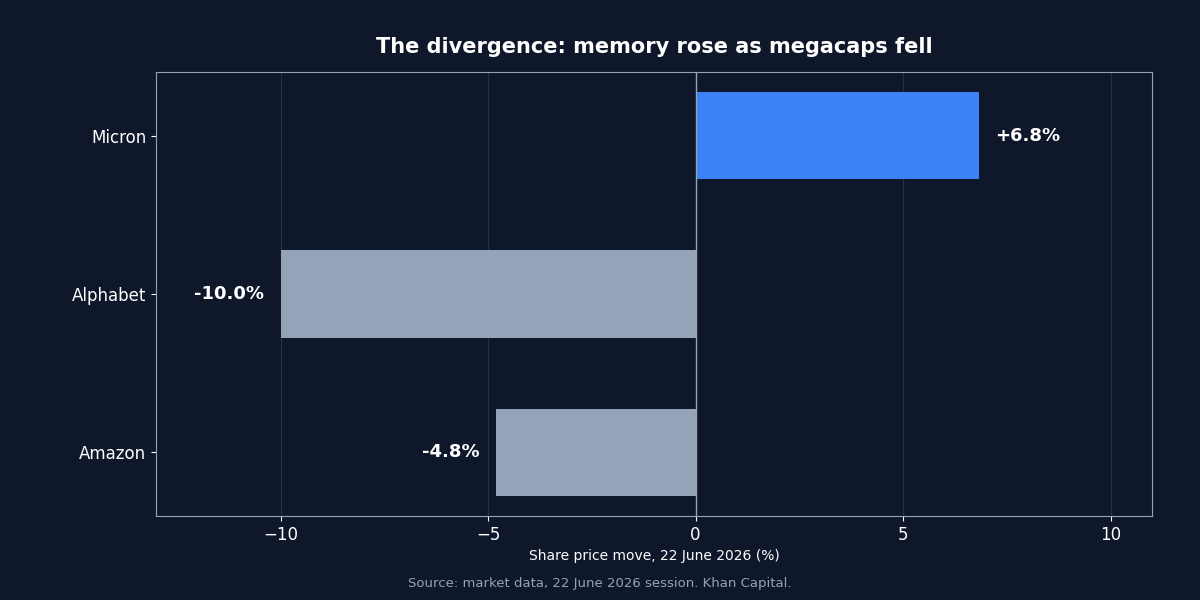
The separation did not hold cleanly. On Tuesday 23 June the broad complex sold off hard, with the Philadelphia Semiconductor Index down 8 per cent and the Nasdaq Composite off 2.2 per cent, and Micron itself fell around 13 per cent into the print before its results reversed the move after the close. The violence of that session, coming so soon after the $1 trillion semiconductor selloff at the start of the month, looks less like a reassessment of demand and more like crowded positioning being forced out of names that had run a long way. The technology sector had gained 27 per cent over the prior three months, the only sector to outpace the wider index, and froth of that order rarely leaves quietly.
What the divergence underlines is that the AI trade has reached the stage where exposure is no longer a thesis. For two years it was enough to own the theme. The questions now being asked, about who has pricing power, who is selling capacity rather than buying it, and who is funding the build-out with cash rather than borrowing, are the questions a maturing trade asks of itself.
The Debt Question Beneath the Build-Out
Beneath the divergence sits a structural shift in how the build-out is being paid for. In the early phase, the hyperscalers funded their capital programmes out of operating cash flow, and the debate was simply whether the scale of AI capital expenditure could ever earn an adequate return. That debate has not been resolved, and in the meantime the financing has changed character. A growing share of the spend is now funded with debt, and the list of borrowers has widened from the established platforms to newly public names tapping the bond market for the first time.
This matters because it changes where the risk sits. When a build-out is equity-financed, a disappointing return shows up as a lower valuation, painful but self-contained. When it is debt-financed, the obligation to service that debt does not flex with the revenue it was meant to produce. The same dynamic was visible in Oracle’s record contracted backlog, where the promise of future cloud revenue was matched by a heavy commitment to build the capacity to deliver it. For a fixed-income desk, the relevant question is no longer whether AI demand is real. It is whether the cash flows arrive on the schedule the borrowing assumes.
Micron sits on the comfortable side of this divide. It is selling capacity, collecting deposits, and generating the cash to fund its own expansion, having raised its full-year capital budget above $25bn from a prior target near $20bn. The contrast between a supplier taking cash up front and a buyer borrowing to secure supply is the cleanest illustration available of where, within the AI complex, the balance of power currently lies.
The Memory Tax Reaches the Consumer
A supercycle confined to the data centre would be a story for equity analysts alone. This one has started to leave it. As HBM production has absorbed an ever larger share of the industry’s wafer capacity, the conventional DRAM and NAND that goes into phones, laptops and servers has tightened, and prices have risen. The clearest sign came when a large consumer-device maker raised prices on laptops and tablets and pointed directly at higher component costs, including memory, as the reason.
That is the moment a specialised industry shortage becomes a broader economic input. The same capacity that is being diverted to feed AI accelerators is the capacity that would otherwise hold down the cost of everyday electronics. The memory tax, in other words, is not only a transfer from cloud operators to chipmakers. It is beginning to reach the household, and it arrives at an awkward moment for an inflation picture that is already re-accelerating on the back of energy. For readers following the macro side of this, the consumer goods channel is worth watching alongside the more familiar energy story.
A Different Kind of Memory Cycle
The instinct of any experienced investor in this sector is to distrust the peak. Memory has humbled every participant who mistook a good year for a permanent one, and the history of the industry is a history of capacity additions arriving just in time to crush the pricing that justified them. The question that decides whether this cycle is different is whether the demand is structural or merely early.
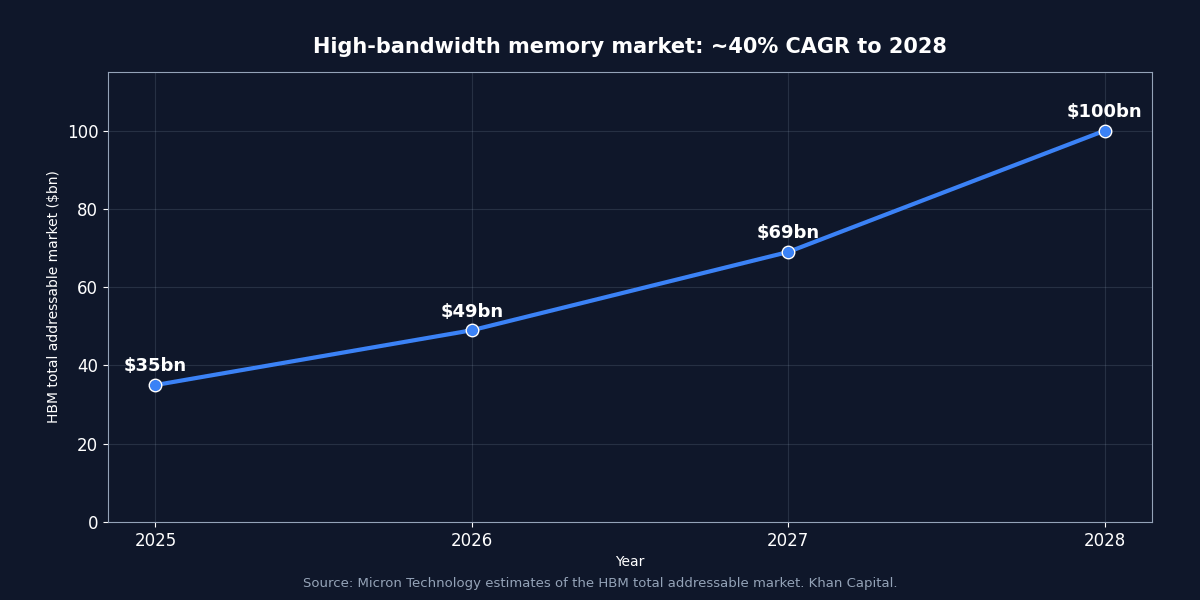
There are reasons to think the structure has genuinely changed. Demand is being expressed not through spot orders but through multi-year contracts with cash deposits attached, which is the opposite of the speculative double-ordering that has marked past peaks. The total addressable market for high-bandwidth memory is projected to grow from roughly $35bn in 2025 to around $100bn by 2028, a compound rate near 40 per cent, and that trajectory is anchored in the physical requirements of accelerator hardware rather than in sentiment. Set against this is the certainty that capacity will eventually respond, that Samsung and SK hynix are racing the same ramp, and that the very margins Micron is now earning are the strongest possible invitation for supply to arrive. A cycle this good carries the seeds of its own correction; the open question is the timing, not the direction.
| Scenario | Through 2027 | What it would take |
|---|---|---|
| Bull | HBM stays sold out; pricing holds; margins above 80% | Accelerator demand keeps outrunning wafer capacity; HBM4 ramp absorbs supply |
| Base | Demand strong but capacity catches up; margins normalise toward the 60s | Samsung and SK hynix add supply on schedule; pricing eases without collapsing |
| Bear | Capacity overshoots into softer demand; a familiar memory downturn returns | AI capex slows or is deferred; double-ordering unwinds; the cycle reverts to type |
Investor Implications
For equities, the quarter sharpens a distinction that the index level obscures. Within the AI complex, the producers of genuinely scarce inputs are demonstrating pricing power and cash generation that the buyers of those inputs cannot yet match, and the market’s willingness on 22 June to reward one while selling the other suggests this distinction is starting to be priced. The risk is not that memory demand is illusory but that the very strength of the print marks a sentiment peak in a notoriously cyclical industry. Comparisons with Nvidia’s record quarter, where an extraordinary beat was met with a muted reception, are a reminder that in a crowded trade the reaction to good news can matter more than the news.
For fixed income, the more important development is the migration of the build-out onto borrowed money. Credit desks that have treated AI as an equity-market phenomenon now have a direct interest in the cadence of returns, because the debt being raised to fund data centres assumes those returns arrive on time. Spreads on the heaviest borrowers, and the terms on which new issuance is absorbed, will say more about the durability of the cycle than any single earnings report.
Across assets, the read-through is that the AI trade is differentiating rather than simply rising or falling as a block. That is healthier than the alternative, but it raises the cost of being wrong about which part of the chain one owns. The era in which exposure to the theme was sufficient appears to be closing.
What to Watch
- Late July 2026: hyperscaler quarterly results and updated capital-expenditure guidance, which will show whether the spending that underwrites memory demand is still being raised or beginning to plateau.
- Through the second half of 2026: the HBM4 ramp and whether it holds the roughly two-times pace management has described, the single best gauge of how much new supply is genuinely arriving.
- Late September 2026: Micron’s next quarterly report against the $50bn guide, the first test of whether the guidance was conservative or stretched.
- Ongoing: DRAM and NAND spot pricing as a read on how far the shortage is spreading from HBM into conventional memory, and how much further the consumer memory tax has to run.
Conclusion
Micron’s quarter is the clearest evidence yet that the AI build-out has produced a genuine supply-constrained memory cycle rather than the speculative episode the sector’s history would lead one to expect. A sold-out order book, deposits taken against capacity that does not yet exist, and a guide to fifty billion dollars in a quarter describe a producer with rare leverage over its customers. The divergence in the tape, the migration of financing onto debt, and the first signs of the memory tax reaching the household are the threads that connect a single earnings report to the wider market. The cycle will turn, as memory cycles always do. What the quarter settles is that, for now, the scarce link in the AI chain is the one most investors spent two years ignoring.
Frequently Asked Questions
What is high-bandwidth memory and why does AI need it?
High-bandwidth memory, or HBM, is a type of memory stacked vertically and placed next to a processor to move data at far higher rates than conventional memory. AI accelerators are limited not only by how fast they can compute but by how fast they can be fed data, which makes HBM an essential and currently scarce component of data-centre hardware.
Why is memory sold out?
Producing HBM consumes a disproportionate share of wafer capacity, so even large producers can make only a limited quantity. Micron has committed its entire 2026 HBM output under multi-year contracts and taken roughly $22bn in customer deposits, and says it can meet only half to two-thirds of the demand it sees, which is why the product is effectively sold out.
Is the AI memory boom a bubble?
Memory is historically cyclical, and the current margins are an invitation for new supply that has crushed pricing in past cycles. What is different this time is that demand is expressed through multi-year contracts with cash deposits rather than speculative spot orders. The structural question is timing: capacity will eventually respond, and the risk is that it overshoots into softer demand.
What does debt-funded AI spending mean for investors?
As more of the AI build-out is financed with borrowing rather than operating cash flow, part of the risk moves from equity valuations to credit. Debt must be serviced regardless of whether the investment earns its expected return on schedule, so a slowdown in AI returns would be felt in credit spreads as well as share prices.
Sources: Micron Technology Investor Relations; US Securities and Exchange Commission, EDGAR; CNBC, Micron earnings; CNBC, market coverage 23 June 2026; TheStreet, market coverage 24 June 2026.
The Khan Capital Brief
Understand what moves markets
Analysis like this, free in your inbox. No spam, unsubscribe any time.
Related Reading: For the supply-chain agreement that anticipated this scarcity, see our analysis of the NVIDIA and SK hynix memory deal. The market backdrop is covered in the $1 trillion AI semiconductor selloff and in our look at how AI capital expenditure reached $725bn. For the muted reception that met an earlier record, read Nvidia’s $91 billion quarter, and for the financing question, Oracle’s record cloud backlog. The consumer-facing consequences of the memory squeeze are examined in the AI memory price shock. The moment the supply premise cracked, when Meta moved to sell its excess compute, is analysed in Meta’s AI Cloud Pivot. For the fundamentals, start with high-bandwidth memory, explained. The cycle question sharpened when Samsung’s ₩89 trillion quarter met a 7 per cent selloff. For the cost of that supercycle to a buyer rather than a maker, see IBM’s worst day on record. For the logic side of the same build-out, see TSMC’s Q2 2026 earnings. See also SK Hynix’s record Nasdaq debut and the Korea discount test.

Leave a Reply