Khan Capitals | July 2026
Key Takeaways
- The truce broke in a single day. Three tankers were struck in the Strait of Hormuz on Tuesday, the most attacks in the waterway in a single day since late April, according to the UN International Maritime Organization.
- Washington’s response was economic first, military second. The US Treasury revoked General License X, the waiver that allowed Iran to sell oil and petrochemicals under the interim deal, with buyers given until 17 July to wind down transactions. Overnight, US forces struck dozens of Iranian targets in retaliatory raids.
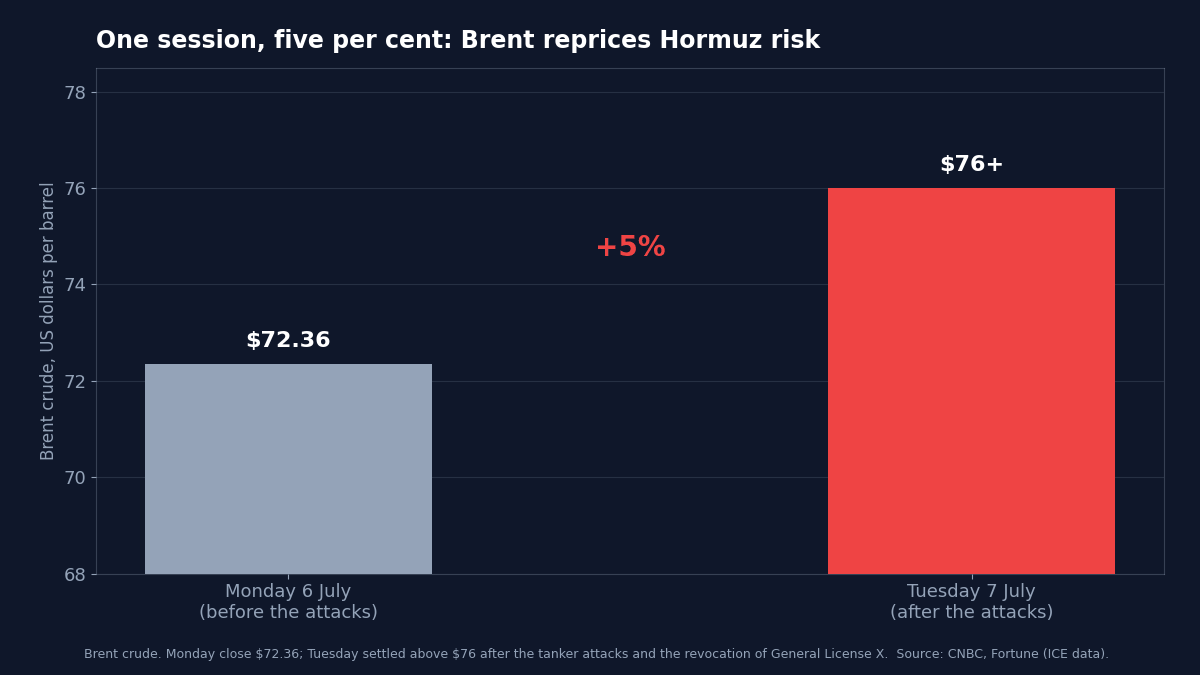
- Oil repriced immediately. Brent crude rose more than 5 per cent on Tuesday to above $76 a barrel, from $72.36 on Monday, with WTI adding a similar amount to trade above $72, per CNBC.
- The timing is loaded. The attacks came during the six-day state funeral of Ayatollah Ali Khamenei, killed in February, with his successor Mojtaba Khamenei yet to appear in public since taking the role. Who ordered the strikes, and whether the centre of the Iranian state currently controls its factions, is the open question under everything else.
- The fear trade stayed dead. Gold, trading near $4,100 an ounce, barely responded. The market is pricing an oil supply problem and an inflation problem, not a global risk-off event; that distinction shapes the investment implications.
Part of: The 2026 Iran Crisis – Khan Capital’s hub on the 2026 Iran crisis and oil shock.
A Ninety-Day Calm, Interrupted
For two weeks the market had been living comfortably inside the logic of the US-Iran interim deal. The 90-day memorandum of understanding agreed in June ended the spring’s fighting, allowed Iranian oil back onto global markets under a Treasury waiver, and unwound the war premium that had distorted risk pricing since the first quarter, a process we charted in our analysis of the peace deal and the collapsing risk premium. Brent had drifted back into the low $70s. Equity markets had recorded their best quarter since 2020 partly on the back of that de-escalation.
The Strait of Hormuz attacks on Tuesday ended that calm in the space of a morning. Three commercial vessels were hit in and around the world’s most important oil chokepoint: a Qatari liquefied natural gas carrier, the Al Rekayyat, which Qatar called an unacceptable attack on international navigation and global energy security; an oil tanker struck on its port side as it exited the strait near the Omani-Emirati border; and a third vessel hit by a drone off Oman. NBC News reported one tanker was set ablaze. Nobody formally claimed the attacks, though Iranian state television, citing anonymous sources, implied Tehran carried out the strike on the gas carrier.
General License X: The Waiver That Held the Deal Together
Washington’s first response was not military but financial. Within hours, the Treasury Department’s Office of Foreign Assets Control revoked General License X, the authorisation that had allowed Iran to sell oil and petrochemicals on world markets as part of the interim arrangement. Buyers of Iranian crude have until 17 July to wind down transactions already in progress. A US official said Iran’s actions in the strait were unacceptable and needed to be met with consequences.
The significance of the revocation is hard to overstate, because the licence was the economic heart of the truce. Iran’s incentive to hold the ceasefire rested substantially on restored oil revenue; removing it converts the interim deal from a mutually beneficial arrangement into a bare military standstill. Overnight into Wednesday, that standstill frayed too: US forces carried out retaliatory strikes on dozens of Iranian targets in the country’s southern coastal and eastern provinces, per CBS News. The deal’s architecture, agreed only weeks ago, is now operating without its economic engine and with live fire on both sides.
| What happened, 7-8 July | Detail |
|---|---|
| Tanker attacks | Three vessels hit in a day, the most since late April (UN IMO) |
| Vessels | Qatari LNG carrier Al Rekayyat; oil tanker near the Omani-Emirati border; a third struck by a drone off Oman |
| US economic response | General License X revoked; wind-down deadline 17 July |
| US military response | Retaliatory strikes on dozens of targets in southern coastal and eastern Iran |
| Brent crude | Up more than 5% to above $76, from $72.36 on Monday |
| WTI crude | Up more than 5% to above $72 |
A Funeral, a Successor, and the Question of Control
The attacks did not happen in a political vacuum. They came midway through the six-day state funeral of Ayatollah Ali Khamenei, the Supreme Leader killed in February’s strikes, an event Tehran has staged as a demonstration of continuity and strength, with authorities anticipating millions of mourners. His son and successor, Mojtaba Khamenei, has not appeared or spoken in public since assuming the role, with US officials describing him earlier this year as wounded in the strike that killed his father.
That context matters for markets because it frames the central analytical question: were Tuesday’s attacks ordered by the Iranian state as calibrated pressure, or carried out by factions, the Revolutionary Guard among them, acting with partial autonomy during a leadership transition? Neither reading is comforting, but they imply different paths. A state-directed provocation is at least negotiable; a fragmenting command structure is not. The honest answer is that outside observers do not know, and the ambiguity itself is a risk input. Investors should be wary of anyone claiming certainty about decision-making in Tehran this week.
The Oil Market Reprices the Strait
The market’s reaction was immediate and, by the standards of past Hormuz scares, disciplined. Brent settled above $76, a gain of more than 5 per cent, and WTI above $72. Roughly a fifth of the world’s oil and a substantial share of its liquefied natural gas passes through the strait, so a 5 per cent move prices a meaningful but far from catastrophic probability of sustained disruption. The move also has to be read against its starting point: crude had been drifting lower since June, when OPEC+ added supply into a falling market and the peace trade compressed the risk premium. Part of Tuesday’s jump is simply that premium being rebuilt.
Two second-order effects deserve attention. First, the revocation of General License X is itself a supply event, independent of any further violence: Iranian barrels that had returned to the market under the waiver now face removal from 17 July. Second, insurance and shipping economics move faster than physical supply. War-risk premia on Gulf transits, rerouting decisions and loading delays tighten effective supply even while every barrel still flows. That is how chokepoint risk usually transmits: through the cost and willingness to carry, not the closure headlines.
History offers a useful calibration. The tanker attacks of summer 2019 and the strike on Saudi Arabia’s Abqaiq processing complex that September, which we examined in our retrospective on the Aramco attack, both produced sharp initial spikes that decayed within weeks once it became clear that flows would continue. The lesson the market internalised from those episodes is that attacking ships is not the same as closing the strait, and that Iran itself depends on the waterway for whatever exports it retains. That precedent explains Tuesday’s relative restraint. What would break the precedent is systematic, sustained targeting of shipping, because insurance markets, not navies, are what actually ration passage through Hormuz.
The Dog That Did Not Bark: Gold
The most revealing market response on Tuesday was the one that did not happen. Gold, the textbook refuge in a Middle East escalation, barely moved, trading near $4,100 an ounce, deep in the bear market we documented in Gold’s Quiet Bear Market. A year ago, three tankers burning in Hormuz would have added $100 to the gold price in a session. This week it could not compete with the rate story: higher oil means higher inflation risk means a more hawkish Federal Reserve, and a hawkish Fed is exactly the environment in which non-yielding gold struggles.
That tells you how the market is classifying this event. It is being priced as an inflation shock and a regional supply shock, not as a global risk-off moment. Equities wobbled but did not break; the dollar firmed modestly; the pressure showed up where it logically should, in oil, in shipping and insurance costs, and in bond yields, which resumed climbing as the inflation arithmetic of $76 crude worked through rate expectations.
Scenario Paths From Here
The range of outcomes is wide and genuinely uncertain; the table sets out the three broad paths and what would signal each.
| Scenario | What it looks like | Signposts |
|---|---|---|
| Contained tit-for-tat | Sporadic attacks and limited strikes; the MoU survives on paper; oil holds a wider risk premium in the $70s | No further attacks on shipping; quiet diplomatic contact resumes; tanker rates stabilise |
| Escalation toward the strait | Systematic targeting of shipping or mining of the waterway; insurers withdraw cover; oil moves sharply higher | Attacks continue daily; Gulf states’ infrastructure targeted; US naval escorts announced |
| Rapid de-escalation | Tehran distances itself from the attacks; License X restored in some form; the premium decays again | Official Iranian disavowal; wind-down deadline extended; back-channel talks reported |
Investor Implications
Equities. The first-order exposures are the obvious ones: energy producers benefit from the repriced barrel, airlines and shipping-dependent industrials absorb the cost. The subtler exposure is the market’s rate sensitivity: if oil holds above $75, the inflation pass-through hardens the case for further Federal Reserve tightening, and the long-duration growth stocks that led the first half carry the discount-rate risk. Energy remains one of the few natural hedges inside an equity portfolio for precisely this scenario.
Fixed income. An oil shock of this kind is unambiguously hostile to bonds: it raises inflation expectations while doing little near-term damage to US growth. Yields rose into and after the attacks, and the pressure sits at the long end, where inflation risk lives. Inflation-linked bonds and short duration positioning are the textbook responses, and this week the textbook logic held.
Cross-asset. The gold non-response is a warning against reaching for yesterday’s hedges. In a regime where the policy rate is the dominant variable, geopolitical shocks transmit through inflation and rates rather than through flight-to-safety flows. Hedging Middle East risk in 2026 has meant owning energy and being short duration, not owning bullion. That holds until the shock becomes big enough to threaten growth itself, at which point the classification flips; the scenarios table above is, in effect, a guide to where that line sits.
What to Watch
- 17 July: The OFAC wind-down deadline for transactions under the revoked General License X, the date Iranian barrels formally leave the market again.
- Coming days: Whether attacks on shipping continue, and whether Tehran officially claims or disavows them; the single most important variable for the oil premium.
- 14 July: US CPI for June, which will start to show how much of the energy repricing feeds the inflation prints the Federal Reserve is watching.
- Early August: The next OPEC+ output decision, now taken against a market where the cartel’s spare capacity is once again the world’s supply buffer.
- September: The nominal expiry window of the 90-day memorandum of understanding, if it survives that long.
Conclusion
Three weeks ago the question hanging over this market was how completely the Iran risk premium would unwind. This week’s answer: not completely, and not for long. The Strait of Hormuz attacks, the revocation of General License X and the retaliatory strikes have converted the interim peace from a trade the market owned with confidence into a truce with live ammunition. The measured scale of the market response, 5 per cent on crude, silence from gold, is not complacency; it is a judgement that this is an oil and inflation event rather than a systemic one. That judgement is reasonable on today’s facts and fragile against tomorrow’s. The wind-down deadline on 17 July, the behaviour of shipping in the strait, and the silence or otherwise of Iran’s unseen new leader will decide which.
Frequently Asked Questions
What happened in the Strait of Hormuz on 7 July 2026?
Three commercial vessels were struck in and around the strait: a Qatari LNG carrier, an oil tanker near the Omani-Emirati border, and a third vessel hit by a drone off Oman. It was the most attacks in the waterway in a single day since late April. No party formally claimed responsibility, though Iranian state media implied Tehran carried out one of the strikes.
What is General License X and why was it revoked?
General License X was the US Treasury waiver allowing Iran to sell oil and petrochemicals on global markets under the interim US-Iran deal. It was revoked on 7 July in response to the tanker attacks, with buyers given until 17 July to wind down existing transactions. Its removal takes away the economic incentive that underpinned the truce.
What do the Strait of Hormuz attacks mean for oil prices?
Brent rose more than 5 per cent to above $76 and WTI above $72 on the day. The move reflects a rebuilt risk premium and the coming removal of Iranian barrels rather than any physical closure of the strait. The path from here depends on whether attacks on shipping continue and whether the wind-down deadline passes without de-escalation.
Sources: PBS News, Three tankers hit in Strait of Hormuz attacks; CNBC, US revokes Iran oil sales authorisation; NBC News, Tanker set ablaze in the Strait of Hormuz; CBS News, US hits dozens of Iranian targets in retaliatory strikes; CNBC, Oil prices rise as US targets Iran; NPR, Dayslong funeral for slain Supreme Leader begins in Tehran.
Related Reading: The essential companion piece is our June analysis of the US-Iran peace deal and the unwinding risk premium, the trade this week reversed. OPEC’s production increase into the peace trade explains the supply backdrop, Gold’s Quiet Bear Market covers the hedge that failed to fire, and the Q1 2026 market correction records what the original war premium did to equities. For the fundamentals, start with why the world has two oil prices and how safe havens work in a crisis. The rates consequence followed within days: the September hike bet returned at 64 per cent. The effect on US inflation showed up a week later in the June CPI report. The escalation continued the following week: see the 20 per cent transit toll that lasted a day and the blockade that followed it. How the escalation moved from missiles to actuarial tables is traced in the invisible blockade repricing Hormuz. For how long-horizon capital has since priced the corridor, see the $16 billion Kuwait pipeline deal. For the latest, see Strait of Hormuz oil flows hit a wartime record as Brent neared $95.

Leave a Reply