Khan Capitals | July 2026
Key Takeaways
- The hike bet is back. A week after the soft June jobs report all but buried it, markets are again pricing a September rate hike at roughly 64 per cent probability, per CME FedWatch data cited by CNBC.
- The minutes revealed a Fed split down the middle. Wednesday’s minutes of the June FOMC meeting showed the committee divided 9 to 8 on a 2026 hike, with nine participants projecting at least one increase this year against none in March, and some arguing the case was already made before standing down to preserve consensus.
- The long end is doing the talking. The 10-year Treasury yield rose 9 basis points on the week to 4.57 per cent, its highest since 22 May and higher in eight of the past nine sessions; the 30-year added 9 basis points to 5.07 per cent, within reach of its 52-week high of 5.18 per cent.
- Oil did the repricing, not the data. The week’s driver was not payrolls or prints but the Strait of Hormuz: Brent’s 5 per cent rise to $76 revived the inflation risk that gives the nine hawkish dots their case.
- Equities are ignoring the argument, for now. The S&P 500 closed the week at a five-week high, SK hynix rose 13 per cent in the third-largest US market debut on record, and next week’s CPI print and bank earnings will test whether that composure is justified.
Part of: The Fed’s Regime Change — Khan Capital’s hub on the Fed’s 2026 regime change.
A Bet That Refused to Stay Buried
Nine days ago, the September rate hike looked like a trade that had died of natural causes. The June employment report, 57,000 jobs against a 115,000 consensus with heavy downward revisions, gave the doves their best data point of the year, and futures markets duly walked back the odds of a September move. The story of this week is how quickly that walk-back reversed. By Friday’s close, the CME FedWatch tool put the probability of a hike at the September meeting at around 64 per cent, and the Treasury market had spent the week trading as if the question were when, not whether.
Two forces drove the resurrection. The first was geopolitical: the tanker attacks in the Strait of Hormuz, the revocation of Iran’s oil sales waiver and the retaliatory strikes that followed, events we covered in The End of the US-Iran Truce, pushed Brent crude up 5 per cent to settle at $76.01 on Friday. Energy is the most direct channel from geopolitics to inflation expectations, and inflation expectations are the entire case for a 2026 hike. The second force arrived on Wednesday at 2pm Washington time, in the form of the June FOMC minutes.
Nine Dots Against Eight: What the Minutes Showed
The minutes of the 16-17 June meeting, at which the committee held the federal funds rate at 3.50 to 3.75 per cent, confirmed what the June dot plot had implied: this is a committee split almost exactly down the middle. Nine of seventeen participants now project at least one rate increase in 2026, three seeing one hike, five seeing two and one seeing three, against eight who project no change and none who projected any hike as recently as March. CNBC characterised it as a family fight that could run for months.

The more revealing detail was procedural. A handful of policymakers argued that the case for a hike had already been made, and backed down in June only to preserve consensus. That is the language of a committee one or two data points away from moving. The minutes also emphasised data dependence and price stability over forward guidance, consistent with the communication style Chair Warsh established at his first meeting in charge, and consistent with the inflation backdrop: core PCE at 3.4 per cent remains far enough above target that the hawks do not need an elaborate argument, merely an absence of disinflation.
| Where the argument stands | Reading |
|---|---|
| Federal funds rate | Held at 3.50-3.75% in June |
| Committee split on a 2026 hike | 9 in favour of at least one, 8 for no change |
| Distribution of hawkish dots | 3 see one hike, 5 see two, 1 sees three |
| March comparison | No participant projected a 2026 hike in March |
| September hike probability | ~64% (CME FedWatch, end of week) |
| 10-year Treasury yield | 4.57%, +9bp on the week, highest since 22 May |
| 30-year Treasury yield | 5.07%, +9bp, 52-week high 5.18% |
The Long End Votes Early
Bond investors did not wait for the committee to resolve its argument. The 10-year yield finished the week at 4.57 per cent, up 9 basis points, higher in eight of the past nine sessions and at its loftiest level since 22 May. The 30-year rose the same amount to 5.07 per cent, closing back within striking distance of the 5.18 per cent that marked the top of May’s global long-bond stress, an episode we examined in The Synchronised Sovereign Rout. The 2-year, at 4.21 per cent, moved less: the curve steepened because the market is repricing inflation risk and term premium, not just the next meeting.
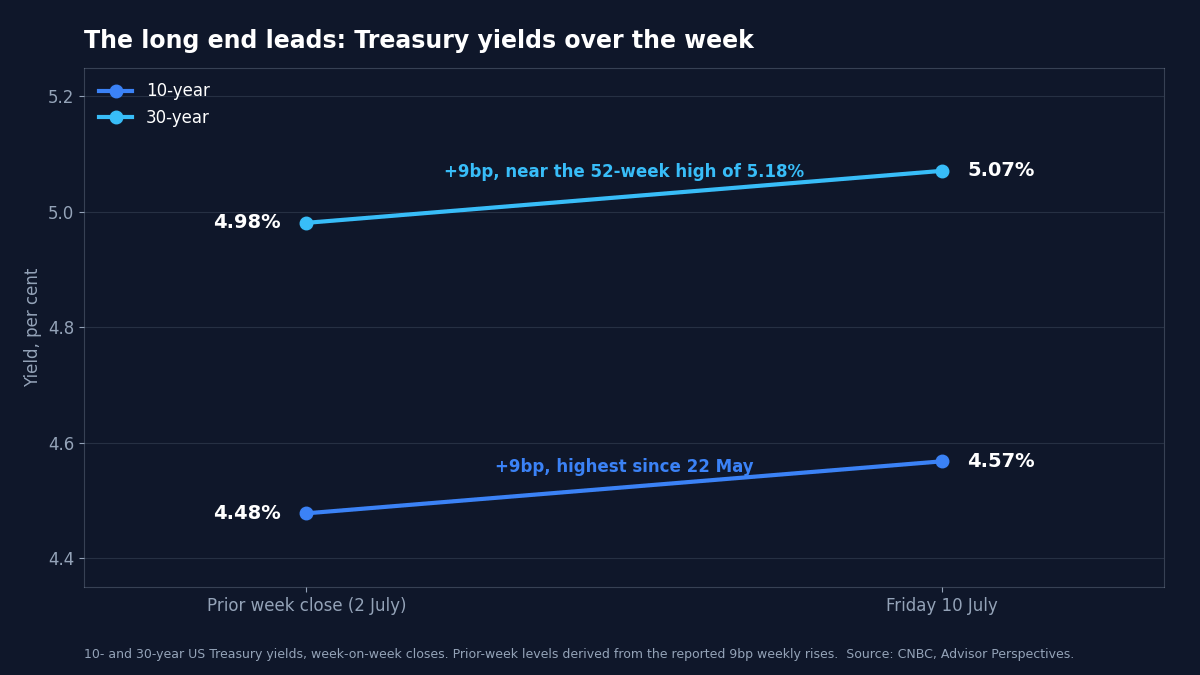
That composition matters. A hike-driven selloff concentrates at the front of the curve; what happened this week was led by the long end, where oil, deficits and inflation uncertainty live. It is the bond market’s way of saying that the risk is not merely one more quarter-point move, but a world in which the Federal Reserve’s next easing cycle keeps receding while the supply of long-dated paper does not. For an equity market trading at record levels on a 29 per cent year-to-date Nasdaq run, the level of the 10-year is the single most important external variable, and it is quietly grinding toward the levels that caused trouble in May.
What a September Rate Hike Would Rest On
Strip the noise away and the September case has three legs. The first is inflation that has stopped falling: core PCE at 3.4 per cent, with the June revision cycle pushing the committee’s own inflation forecasts sharply higher. The second is an economy that, one soft payrolls print notwithstanding, refuses to weaken convincingly: equities at records, credit spreads tight, financial conditions loose enough that the AI capex boom is being funded without strain. The third leg arrived this week: an oil shock with no obvious expiry date, which mechanically lifts headline inflation over the exact horizon the September and October meetings will be judging.
The counter-case is the labour market. Payroll growth of 57,000 with negative revisions is the kind of number that historically precedes easing, not tightening, and the doves will argue that hiking into visible labour softening repeats a classic policy error. That argument lost ground this week not because it is wrong but because oil moved the risk calculus: a committee worried about its inflation credibility can tolerate a cooling labour market more easily than a second inflation wave of its own making. Hence the market’s asymmetric response, repricing the hike sharply while barely moving the recession probabilities.
The Tape That Refuses to Worry
Set against all this, equity markets had a strikingly good week. The S&P 500 rose 0.4 per cent on Friday to close at a five-week high; the technology sector gained about 3 per cent over the week and energy 3.1 per cent, the two sectors telling the week’s two stories in miniature. Friday also brought a data point on risk appetite that no rates model captures: SK hynix’s American depositary receipts rose 13 per cent on their Nasdaq debut after the company raised $26.5 billion, the largest US share sale ever by a foreign company and the third-largest debut on record. Days after a chip rout, a trillion-dollar memory maker was met with enthusiastic demand.
The equity market, in other words, is treating the return of the hike as a manageable tax on valuations rather than a threat to the cycle. It has been right to do so all year; the best quarter since 2020 was built on exactly this composure. The vulnerability is sequencing. If Tuesday’s CPI comes in hot while oil holds above $75, the September hike moves from probable to presumptive, the 10-year tests its May highs, and the long-duration end of the equity market has to re-run the discount-rate arithmetic it has been deferring since spring.
Paths to the September Meeting
| Path | What it needs | Likely market expression |
|---|---|---|
| September hike | Firm June-July CPI prints; oil holding $75+; labour data stabilising | Front-end yields rise to meet the long end; dollar firms; growth equities compress |
| Hawkish hold | Mixed inflation data; oil premium decays; committee preserves consensus again | Curve steepens further; volatility around each print; equities grind on |
| Hike bet fades again | Soft CPI; renewed labour deterioration; Iran de-escalation takes oil back to $70 | Long end rallies; gold stabilises; the June playbook returns |
Investor Implications
Equities. The index level is concealing a rotation that the rates market is driving: energy and financials benefit from the steepening, while the longest-duration growth names carry the discount-rate risk. Bank earnings, which begin next week, arrive with a tailwind few anticipated in June: a steeper curve is raw material for net interest margins. The record-high tape deserves respect, but position sizing should acknowledge that the 10-year at 4.57 per cent is 60 basis points of valuation headwind that did not exist in April.
Fixed income. The week reinforced the year’s core discipline: the risk sits at the long end. Short-dated paper at 4.2 per cent offers respectable carry while the committee argues; duration extension keeps being punished by exactly the term-premium dynamics on display this week. Inflation-linked bonds remain the direct expression of the view that oil and tariffs keep headline inflation sticky through the autumn.
Cross-asset. The regime is coherent once named: a supply-shock-tinged inflation environment with a central bank whose next move is likelier up than down. That configuration favours energy over gold, short duration over long, and pricing-power equities over rate-sensitive ones. It is uncomfortable precisely because it is the mirror image of the playbook that worked from 2023 to 2025, and portfolios built on the old regime’s reflexes keep being surprised by weeks like this one.
What to Watch
- 14 July: US CPI for June, the single print with the most power to convert the 64 per cent September probability into something close to certainty, or to unwind it.
- 14-15 July: Second-quarter earnings from JPMorgan, Citigroup, Goldman Sachs, Wells Fargo, Bank of America and Morgan Stanley, with net interest income guidance the clearest read on how banks see the rate path.
- This week ahead: June PPI and retail sales, filling in the inflation and demand picture ahead of the Fed’s blackout period.
- 17 July: The Iranian oil wind-down deadline, the pivot point for whether the energy impulse to inflation persists into the autumn prints.
- Late July: The next FOMC meeting, at which the nine-versus-eight argument gets its next formal airing.
Conclusion
Markets spent June debating whether the Federal Reserve’s regime change was real, and the first week of July supplied the answer in an unexpected form. It took precisely one oil shock to restore the September rate hike to near-consensus status, because the committee, split nine to eight with its hawks openly biding their time, was already leaning against the door. The 10-year at a seven-week high, the 30-year within sight of its cycle peak, gold at $4,100 and energy leading the sector table are all the same sentence written in different asset classes: the market believes the next move in the price of money is more likely up than down. Tuesday’s CPI print will either harden that belief into positioning or hand the doves one more reprieve. What it will not do is end the argument. Nine dots against eight is not a forecast; it is a coin standing on its edge, and every data point between now and September is a tap on the table.
Frequently Asked Questions
Will the Fed raise interest rates in September 2026?
Markets priced the probability of a September rate hike at roughly 64 per cent at the end of the week of 10 July, per the CME FedWatch tool. The June FOMC minutes showed nine of seventeen participants projecting at least one 2026 hike. The outcome most likely turns on the June and July CPI prints and whether oil holds its post-Hormuz gains.
What did the June 2026 FOMC minutes reveal?
The minutes, released on 8 July, showed a committee split 9 to 8 on raising rates in 2026, with some policymakers arguing the case for a hike had already been made before standing down to preserve consensus. The committee held the federal funds rate at 3.50 to 3.75 per cent and stressed data dependence over forward guidance.
Why are Treasury yields rising in July 2026?
The 10-year yield rose to 4.57 per cent, its highest since late May, driven by the oil price shock from the renewed US-Iran confrontation, hawkish FOMC minutes and growing expectations of a 2026 rate hike. The move was led by the long end of the curve, reflecting repriced inflation risk and term premium rather than only the next policy decision.
Sources: CNBC, Fed’s family fight over rates could drag on; Federal Reserve, FOMC meeting calendars and minutes; Advisor Perspectives, Treasury yields snapshot 10 July 2026; CNBC, Oil posts weekly gain as Middle East supply risks persist; CNBC, SK Hynix rises 13% in Nasdaq debut; CNBC, Stock market outlook for 13-17 July.
Related Reading: The immediate backstory is the June jobs report that faded the hike and the Hormuz attacks that brought it back. For the architecture of the Fed’s shift, see Warsh’s first FOMC and the hawkish hold, the June repricing from cuts to hikes and May’s synchronised sovereign bond rout. For the fundamentals, start with how the dot plot works and why Fed minutes move markets. The print that followed is covered in the June CPI report, which cut September odds to 63 per cent without killing the trade. The same oil-driven repricing has reached Britain: see UK gilt yields above 5% as Burnham takes office. The oil shock keeping the hike alive is dissected in the invisible blockade repricing Hormuz, and its credit-market complacency in spreads at the first percentile. The other side of the Atlantic divide is covered in the ECB’s hawkish hold. The trade-policy shock that followed is covered in the US forced labour tariffs.

Leave a Reply