
Khan Capitals | July 2026
Key Takeaways
- Andy Burnham became prime minister on Monday 20 July, succeeding Keir Starmer unopposed as the UK’s seventh prime minister in a decade, and appointed John Healey as chancellor in place of Rachel Reeves.
- The gilt market delivered its verdict within hours. The 10-year yield moved back above 5 per cent and the 30-year rose towards 5.75 per cent, the highest since late May, after Burnham said he would seek “any flexibility” within the government’s fiscal rules.
- The first policy act cut taxes, not spending. Burnham and Healey scrapped VAT on household electricity from October at a cost of £850 million in 2026-27, funded by cancelling the Digital ID programme, a small number with a large signal attached.
- The Bank of England now shares the stage. With Bank Rate at 4 per cent, oil above $80 and inflation concerns revived, money markets price roughly 68 basis points of hikes for 2026, with the first move expected as early as the autumn.
- Equities are not the pressure point. The FTSE 100 closed the week at 10,600 near record levels; the fiscal credibility question is being litigated almost entirely in the long end of the gilt curve.
A Handover the Market Had Already Priced, Until It Spoke
The transition itself was the least dramatic in years. Andy Burnham succeeded Keir Starmer unopposed, a coronation rather than a contest, and the broad shape of it had been visible since the resignation we analysed when the gilt market first priced a change in Westminster. What moved UK gilt yields this week was not the handover. It was the new prime minister’s first sentences about borrowing.
Asked about the fiscal rules he inherits, Burnham said he would follow them while seeking “any flexibility” available within them. To a lay ear that is a politician keeping options open. To the gilt market it was a probe of the fence, from a politician who said only last year that the country should not be “in hock” to the bond market. Long-dated yields rose to their highest since late May within the session. The 10-year, which had eased to around 4.93 per cent earlier in July, moved back above 5 per cent. The 30-year pushed towards 5.75 per cent.
The appointment of John Healey as chancellor, replacing Rachel Reeves, completed the picture the market is now pricing: a new team, an unchanged arithmetic, and a leader whose instincts on borrowing are, at minimum, untested against a bond market that has spent two years charging Britain more than almost any other developed borrower for long-term money.
| Indicator | Level | Context |
|---|---|---|
| 10-year gilt yield | Above 5% | Back above the threshold after easing to ~4.93% earlier in July |
| 30-year gilt yield | ~5.75% | Highest since late May; May’s peak was 5.79% |
| Bank Rate | 4.00% | Market prices ~68bps of hikes for 2026 |
| FTSE 100 | 10,600 | Closed the week near record levels |
| Brent crude | Above $80 | Keeping UK inflation expectations elevated |
Why UK Gilt Yields Carry the Whole Argument
The striking feature of this episode is where it is happening. Sterling wobbled but did not break. The FTSE 100, stuffed with overseas earners, finished the week at 10,600, close to its records. The entire dispute between the new government and the market is being conducted in one venue: the long end of the gilt curve, where the yield premium over Bank Rate now stretches to roughly 175 basis points at thirty years.
That gap is not a forecast of Bank Rate. It is mostly term premium: the extra compensation investors demand for holding long British debt through decades of fiscal and inflation uncertainty. The UK’s structural buyers of long gilts, the defined-benefit pension funds that once absorbed issuance almost mechanically, have been shrinking for years, leaving price-sensitive buyers to set the marginal yield. When those buyers hear a new prime minister muse about flexibility, they do not sell Britain; they simply charge more for the privilege of lending to it for thirty years.
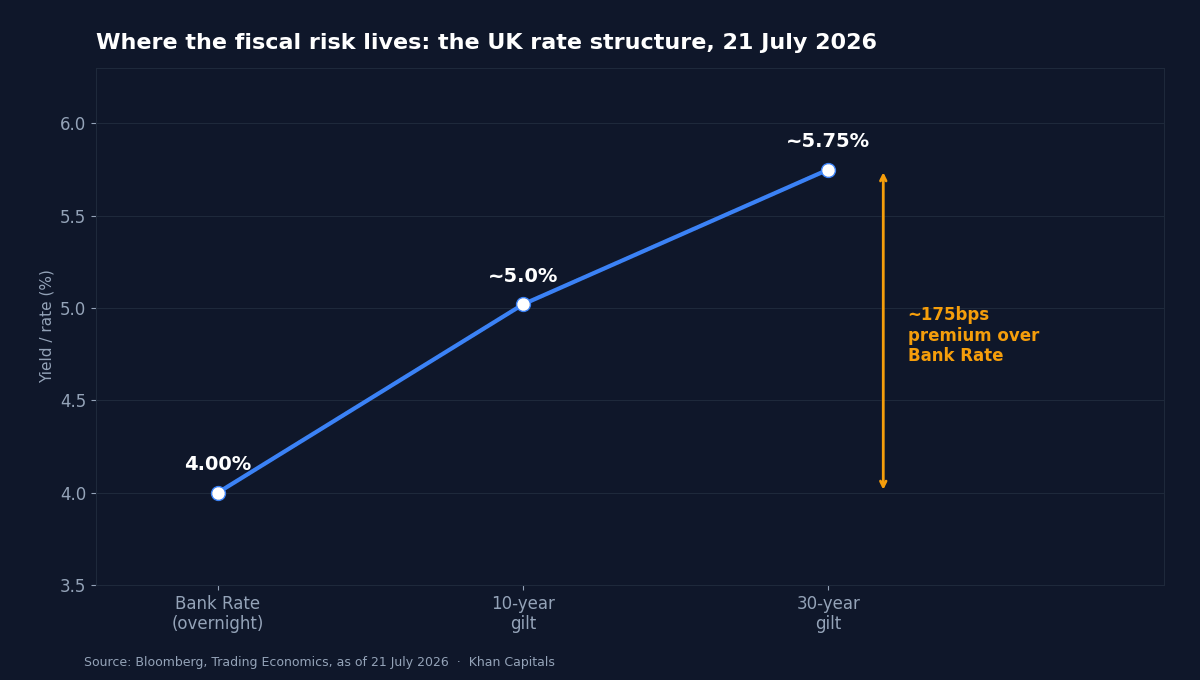
This is the quiet discipline the market now applies everywhere: not the dramatic buyers’ strike of the 2022 mini-Budget, but a slow ratchet in the price of long money. Each episode resets the baseline a little higher. The 30-year traded as high as 5.79 per cent in May, a level last seen at the turn of the century; this week’s move back towards 5.75 per cent shows how little goodwill the market extends while the questions stay open.
Seven Prime Ministers, One Bond Market
Burnham is the seventh UK prime minister in a decade, a churn rate without modern precedent in a G7 country. That fact is itself a market input. Political instability compresses the horizon over which investors will underwrite policy, and a shortened policy horizon shows up directly in the term premium. A government that may not survive to deliver its own medium-term fiscal plan cannot fully bind its successor, and the market prices the possibility accordingly.

The comparison the market cannot stop making is with 2022. Then, an unfunded fiscal package met a leveraged pension system and produced a genuine dysfunction that forced the Bank of England to intervene. The safeguards built since make a mechanical repeat unlikely. But the deeper lesson of 2022 was not about leverage; it was that the UK’s fiscal credibility is now conditional, renewed or eroded with every statement, rather than assumed. Burnham’s opening week eroded a little of it. The £850 million electricity VAT cut is fiscally trivial and even prudently funded through the cancelled Digital ID programme, but its sequencing, a tax cut as the first act, told investors which way the new government’s instincts lean.
The international comparison sharpens the point. Other heavily indebted democracies have changed leaders repeatedly without paying Britain’s premium, because their institutional anchors, independent fiscal councils, long average debt maturities, captive domestic savings, absorbed the political noise. The UK retains some of those anchors, including one of the longest average debt maturities among major borrowers, which slows the pass-through of higher yields into the interest bill. But maturity is a buffer, not an exemption. Debt still has to be rolled at today’s prices eventually, and every year of five per cent long yields converts a little more of the old cheap debt into new expensive debt.
The Bank of England’s Unwelcome Company
The fiscal story lands on a monetary market that was already tightening. With Brent above $80 on the renewed Gulf conflict, the disinflation the UK enjoyed in the spring has stalled, and money markets now price roughly 68 basis points of Bank of England hikes for 2026, with the first plausible move as early as October or November. The parallel with the United States is close: the same oil shock that revived the Fed’s September hike debate is pushing UK rate expectations higher, and the same energy channel runs through the Strait of Hormuz.
For a new government, this is the worst possible monetary backdrop. Fiscal loosening into a central bank tightening cycle forces the two arms of policy against each other: every unfunded pound of stimulus becomes an argument for a higher Bank Rate, and every hike raises the cost of servicing the debt the stimulus created. Britain has run this loop before, and gilt investors know its steps by heart. The market’s message to Burnham is not that flexibility is forbidden. It is that flexibility, at this point in the cycle, is expensive.
What Would Calm the Long End
The path to lower long yields is well mapped, because other governments have walked it. It requires the autumn Budget to pair any giveaways with credible, dated consolidation; it requires the fiscal rules to survive the search for flexibility intact; and it requires the government to resist the temptation to treat the gilt market as an adversary in public. Burnham’s “in hock” framing from opposition is precisely the rhetoric the market will watch for in office. Governments do not need bond investors to like them. They need investors to believe the arithmetic.
The alternative path is also well mapped. If the autumn Budget leans on optimistic growth assumptions or undated savings, the ratchet resumes: higher long yields, a heavier interest bill, a tighter fiscal box, and a government with less room than the one before it. At current debt levels, each 100 basis points on the average cost of borrowing eventually feeds through to a double-digit billion annual interest cost, money that buys no schools, no hospitals and no votes.
| Scenario | Fiscal path | Gilt market implication |
|---|---|---|
| Credibility rebuilt | Autumn Budget pairs giveaways with dated consolidation; rules intact | Term premium compresses; 30-year drifts back below 5.5% |
| Muddling through | Rules formally observed; flexibility used at the margin | Long yields rangebound at elevated levels; each event resets the floor higher |
| Credibility tested | Unfunded loosening or a public fight with the fiscal framework | Long-end selloff; BoE forced into a harder line; 2022 comparisons return |
The Chart to Watch
The 10-year gilt yield is the market’s running verdict on the new government. Five per cent is the psychological line; the May highs are the technical one. A sustained break above both, without an accompanying global bond selloff, would mark the premium as specifically British.
Investor Implications
Fixed income. The long end of the gilt curve now embeds a political risk premium that will be repriced on every fiscal headline between now and the autumn Budget. For sterling investors, the front end is the calmer home: it is anchored by a Bank of England whose reaction function is at least legible, while the 30-year trades on statements no model can forecast. The cross-market comparison matters too: UK long yields already sit above their US and European counterparts, so the incremental compensation for the next unit of fiscal risk is thinner than the headline yields suggest.
Equities. The FTSE 100’s resilience is real but narrow: it is a global index priced in a weakening currency, not a bet on the UK economy. The domestic exposure sits in the mid-caps and the banks, where higher-for-longer UK rates cut both ways, supporting margins while pressuring credit demand and mortgage books. A gilt-led risk repricing would reach them first.
Cross-asset. Sterling is the pressure valve to watch. The currency has so far treated the transition as noise, which suggests the market believes the institutions will hold the arithmetic together. If long gilt yields keep rising while sterling starts falling, that combination, the 2022 signature, would signal the market moving from repricing Britain to distrusting it. That line has not been approached this week. It is the one that matters.
What to Watch
- Early August: the Bank of England’s next MPC decision, the first with the new government in place; the vote split and the language on oil-driven inflation will shape how much of the 68 basis points priced for 2026 survives.
- Late summer: the government’s first significant gilt auctions under Healey, the cleanest read on real demand for long-dated UK debt at these yields.
- October: the electricity VAT cut takes effect, a small but visible test of whether the new government’s giveaways stay funded.
- Autumn: Healey’s first Budget, the event on which the entire credibility question now converges; the treatment of the fiscal rules will move the long end more than any rate decision.
Conclusion
Britain has changed prime minister without changing its predicament. The debt is the same, the interest bill is the same, and the buyers of long gilts are the same sceptical audience they were a week ago. What changed on Monday is the voice making the argument, and the market’s opening assessment of that voice was to add a few basis points to the price of thirty-year money.
None of this is a crisis, and it is worth resisting the vocabulary of one. Yields above 5 per cent are a constraint, not a catastrophe: the ordinary cost of borrowing for a heavily indebted country that keeps asking its creditors for patience. The question Burnham’s government will answer between now and the autumn Budget is whether it treats that constraint as a fact to be managed or a fight to be picked. Gilt investors have seen both approaches this decade. They have repriced accordingly each time.
Frequently Asked Questions
Why did UK gilt yields rise when Burnham became prime minister?
The trigger was Burnham’s comment that he would seek “any flexibility” within the government’s fiscal rules, which investors read as an appetite for more borrowing. Long-dated gilt yields rose to two-month highs, with the 10-year back above 5 per cent and the 30-year near 5.75 per cent, as the market added a premium for fiscal uncertainty under the new government.
Who is the UK chancellor under Andy Burnham?
John Healey was appointed chancellor of the exchequer on 20 July 2026, replacing Rachel Reeves. His first announced measure, jointly with Burnham, was cutting VAT on household electricity bills from 5 per cent to zero from October, costing £850 million in 2026-27 and funded by scrapping the Digital ID programme.
Is this a repeat of the 2022 mini-Budget crisis?
Not on current evidence. The 2022 episode involved a large unfunded fiscal package colliding with leveraged pension strategies, forcing Bank of England intervention. This week’s move has been an orderly repricing: yields at two-month highs, sterling stable, and equities near records. The warning combination to watch is rising long yields alongside a falling pound, which has not occurred.
Will the Bank of England raise interest rates in 2026?
Money markets currently price roughly 68 basis points of Bank of England rate rises for 2026 from the current 4 per cent Bank Rate, with the first hike considered possible as early as October or November. The pricing reflects oil above $80 and the risk that fiscal loosening adds to inflation pressure; it is a market expectation, not a certainty.
Sources: Bloomberg, CNBC, Morningstar / Alliance News, Fortune, IG, Trading Economics.
Related Reading: The first act of this repricing is covered in our analysis of the gilt market and Starmer’s resignation, while the parallel tightening debate in the United States runs through the September rate hike repricing. The rate trade’s wider casualties appear in gold’s quiet bear market and the yen at a 40-year low. For the fundamentals, start with the term premium, explained and how monetary and fiscal policy pull against each other. The euro area’s parallel tightening dilemma is examined in the ECB’s hawkish hold. The property-market consequences are examined in UK property investment under PM Burnham. For the meeting that pulled yields back from the brink, see the Bank of England’s dovish hold. The first full growth reading under the new government arrived in August: see UK Q2 GDP growth and what actually drove it. Gilts later joined a synchronised move covered in the global bond selloff of August 2026.

Leave a Reply