Khan Capitals | July 2026
Key Takeaways
- A 6-3 hold at 3.75 per cent. The Monetary Policy Committee held Bank Rate for the fifth consecutive meeting on 30 July, with Catherine Mann, Megan Greene and Chief Economist Huw Pill voting for a quarter-point increase.
- Bailey buried the hike. With CPI inflation at 2.6 per cent, below the Bank’s own expectations, the Governor told markets not to leave the room thinking policymakers were edging toward an increase, directly rejecting the message of his three dissenters.
- The gilt market believed him. Two-year gilt yields fell eleven basis points to 4.34 per cent, the steepest drop since 12 June, and the 10-year slipped back below 5 per cent as September hike bets were slashed.
- The forecast points down, eventually. The July Monetary Policy Report projects inflation peaking at 3.2 per cent in Q4 2026 before undershooting the target at 1.7 per cent in early 2028, an undershoot that quietly argues the market’s priced hikes are too many.
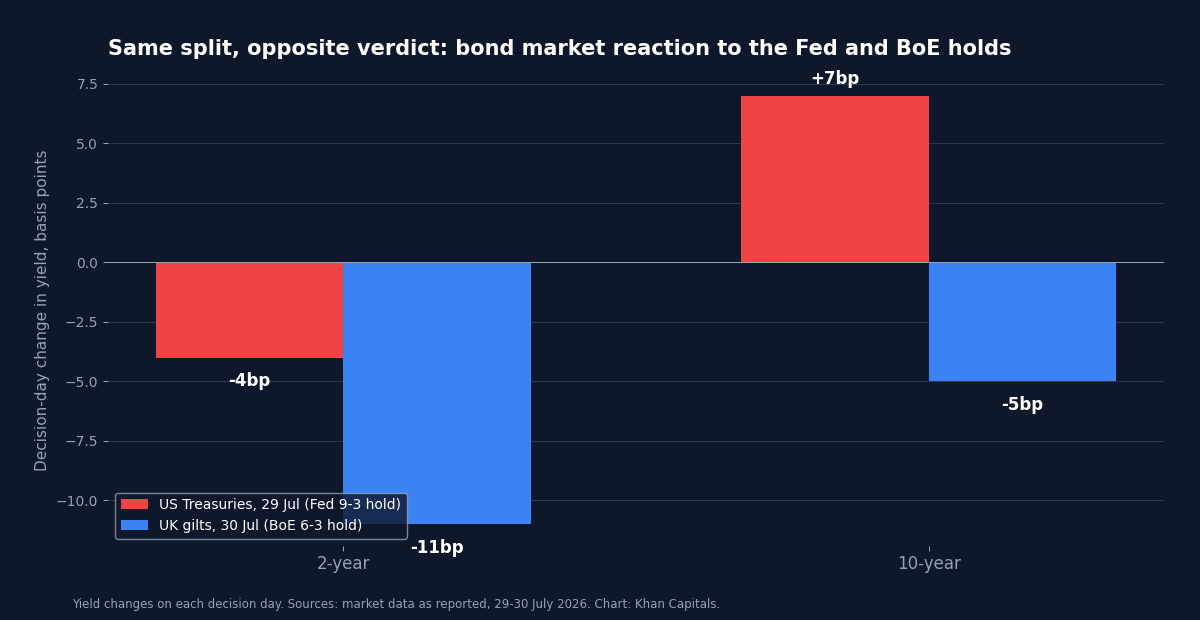
- A mirror image of the Fed. Twenty-four hours earlier the Fed also held with three hawkish dissenters, but where Chair Warsh refused to guide and long Treasury yields surged, Bailey guided dovish and gilts rallied: same split, opposite verdict.
Three Votes for a Hike, One Sentence That Buried It
The Bank of England hold on 30 July was, on paper, a carbon copy of the Federal Reserve decision a day earlier: a major central bank keeping rates unchanged over the objection of three committee members demanding an immediate increase. The Monetary Policy Committee voted 6-3 to keep Bank Rate at 3.75 per cent, where it has stood all year. Catherine Mann and Megan Greene were joined in dissent by Huw Pill, the Bank’s Chief Economist, an unusually senior voice to find on the losing side of a rate vote.
What separated London from Washington was everything that happened after the vote. Where Kevin Warsh declined to characterise the path of policy at all, Andrew Bailey used his press conference to do the opposite of his dissenters’ bidding. Inflation, he noted, had fallen to 2.6 per cent, below where the Bank thought it would be at this point, an outcome he called encouraging even as he flagged that energy prices remain high and volatile because of the conflict in the Middle East. Pressed on whether three votes for a hike meant the committee was moving toward one, Bailey told attendees not to leave the room thinking policymakers were edging toward an increase. It was as close to a verbal easing as a governor can deliver without touching the rate.
| Item | Detail |
|---|---|
| Decision | Bank Rate held at 3.75%, fifth consecutive meeting |
| Vote | 6-3 |
| Dissenters | Mann, Greene, Pill, all for +25bp to 4.00% |
| CPI inflation | 2.6%, below the Bank’s expectations |
| Projected peak | 3.2% in Q4 2026, then falling |
| Market reaction | 2-year gilt -11bp to 4.34%; 10-year back below 5% |
The Forecast Behind the Bank of England Hold
Bailey’s confidence rests on the July Monetary Policy Report, whose central projection tells a story of one final hump rather than a renewed spiral. Inflation is expected to climb from 2.6 per cent to a peak of 3.2 per cent in the fourth quarter of this year, driven substantially by energy costs that trace back to the Gulf conflict, before falling steadily to just 1.7 per cent in the first quarter of 2028, below target, and settling at 1.9 per cent in late 2029. Growth is projected to run at a modest 1.1 per cent annual pace through 2027 before firming toward 1.7 per cent.
The subtlety is in the conditioning. The projection is built on the market-implied rate path, which prices a high chance of two further hikes by the third quarter of 2027. Run the economy on that path, the Bank’s models say, and inflation lands below target. In central banking grammar, publishing an undershoot on market rates is a polite way of saying the market has priced too much tightening. The committee judged risks to the outlook as tilted to the upside, a hedge that keeps the hawks on the pitch, but the central case is doing the heavy lifting, and the central case is dovish. The dissenters’ argument, that a 3.2 per cent peak against a backdrop of volatile energy is not the moment to relax, lost to a forecast that treats the peak as arithmetic rather than momentum.

The Gilt Market Believed Him
The reaction in gilts was immediate and concentrated exactly where policy expectations live. The two-year yield dropped eleven basis points to 4.34 per cent, its steepest one-day fall since 12 June, as traders slashed the probability of a September increase. The 10-year followed, falling around five basis points to just below the 5 per cent line it had breached in the days after Andy Burnham’s arrival in Downing Street pushed long yields to fiscal attention levels. For a market that has spent the summer trading Westminster headlines, it was a reminder that the Bank can still move the curve when it chooses to speak clearly.
The comparison with the previous day’s session in Treasuries is the sharpest way to see what Bailey achieved. After the Fed’s 9-3 hold, US two-year yields fell modestly but the long end sold off hard, with the 30-year reaching a 19-year high: markets read silence as tolerance. After the BoE’s 6-3 hold, the entire front of the UK curve rallied: markets read guidance as intent. Same vote pattern, opposite curves. The chart below sets the two decision days side by side.
A Tale of Two Committees
The transatlantic mirror deserves a moment, because the two committees reached the same vote from opposite positions. The Fed’s hawks, as we detailed in our analysis of the triple dissent, are reacting to more than five years of above-target inflation; their case is about credibility erosion. The Bank of England’s hawks are reacting to a forecast peak that has not yet arrived; their case is about insurance. And the two chairs diverged precisely on the value of words: Warsh believes guidance spends credibility, Bailey believes it conserves it. One day apart, markets delivered their verdicts: the Fed’s silence cost the US long end twelve basis points, while Bailey’s sentence bought the UK front end eleven.
There is also a structural difference worth holding on to. The UK’s inflation problem of 2022-2023 was imported energy; its inflation position of 2026 is again substantially about energy, now via the Gulf. A committee that believes its inflation is being set in the Strait of Hormuz rather than the high street can rationally look through a forecast peak. The Fed’s overshoot, by contrast, has broadened across services and wages over five years, which is why its hawks speak in the vocabulary of regime rather than shock. The same three-dissent arithmetic conceals two entirely different inflation diagnoses.
UK 10-year gilt yield. Chart: TradingView.
The Burnham Variable
None of this happens in a fiscal vacuum. The gilt market’s summer has been dominated by the new Prime Minister’s spending signals, from the fiscal flexibility remarks that first repriced UK credibility in June to the housing agenda we examined in our analysis of property under Burnham. The Bank’s dovish tilt helps the front end of the curve, but the long end answers to the Treasury, and a 10-year yield hovering at 5 per cent with a Budget approaching leaves little room for fiscal surprises. The risk map is asymmetric: a dovish Bank plus a disciplined Budget could pull the whole curve lower into year-end, while a dovish Bank plus a loose Budget re-runs the term premium problem with less monetary cover.
Sterling sits in the middle of that equation. A central bank guiding away from hikes while the Fed’s hawks gather strength is, mechanically, a rate-differential story against the pound, and the currency’s path into the autumn will depend on which committee blinks first. A weaker pound would push imported inflation back into the Bank’s forecast just as the projected peak arrives, which is the scenario in which the July dissenters are rehabilitated quickly.
Investor Implications
Equities. A front-end rally is most valuable to the UK’s rate-sensitive domestic cohort: housebuilders, real estate and the mid-cap consumer names whose financing costs track the short end. The FTSE 100 advanced on the day, but the sharper story is relative: UK domestics have traded at a persistent discount through the fiscal noise, and a Bank willing to guide dovish removes one of the two overhangs. The other, the Budget, remains. Exporters face the mirror image; a softer pound flatters overseas earnings even as it complicates the inflation path.
Fixed income. The gilt curve now embeds a dovish Bank and a fiscally untested government, which argues for steepening pressure: the front end anchored by Bailey’s guidance, the long end hostage to the autumn Budget and to a term premium that has been rebuilding all year. The 2s10s gap widened on the day, and the conditioning of the Bank’s own forecast, an inflation undershoot on the market path, is an explicit invitation to the front end to rally further if the data cooperate.
Cross-asset. The pound is the cleanest expression of the July divergence: short sterling rallied while the dollar rode a hawkish dissent story, and that policy gap either closes via US data softening or widens into a trend. For global portfolios the week’s larger lesson is that central bank communication is again a market factor in its own right: two identical votes produced opposite curves purely on the chairs’ choice of words.
What to Watch
- Mid-August: July UK CPI; the first test of whether the climb toward the projected 3.2 per cent peak stays on the Bank’s script.
- Mid-August: UK labour market data; wage growth is the swing variable between the majority’s patience and the dissenters’ insurance argument.
- Mid-September: the next MPC decision, with markets now pricing materially lower odds of a hike than before 30 July.
- Autumn: the Budget, the event the long end of the gilt curve is actually waiting for.
Conclusion
The July hold will be recorded as 6-3, but the number that mattered was one: a single sentence from the Governor that told markets the dissent was noise. With inflation surprising to the downside, a forecast that undershoots on the market’s own rate path, and an energy-driven peak he is prepared to look through, Bailey chose to spend words where Warsh hoarded them, and the gilt market paid him for it. The test arrives in the autumn, when the projected peak, the wage data and the Budget land together. If the forecast holds, July was the meeting the UK hiking debate ended. If energy or the Treasury misbehave, three dissenters are waiting to say they told him so.
Frequently Asked Questions
Why did the Bank of England not raise interest rates in July 2026?
The majority of the Monetary Policy Committee judged that inflation, at 2.6 per cent, had fallen faster than expected and that the projected rise to 3.2 per cent late in 2026 is driven largely by energy prices linked to the Middle East conflict. The Bank’s own forecast shows inflation undershooting the 2 per cent target by 2028 if it followed the rate path markets had priced, which argued against tightening further.
Who voted for a rate rise at the July 2026 MPC meeting?
Three of the nine members: external members Catherine Mann and Megan Greene, and the Bank’s Chief Economist Huw Pill. All three preferred an immediate quarter-point increase to 4.00 per cent. The other six members, including Governor Andrew Bailey, voted to hold at 3.75 per cent.
When could UK interest rates change next?
The MPC’s next scheduled decision is in mid-September 2026. After Governor Bailey’s comments on 30 July, markets sharply reduced the probability of a September increase, though the committee has stressed that the path depends on inflation, wage data and energy prices over the coming months. Nothing in this article is investment advice.
Sources: Bank of England Monetary Policy Summary, July 2026; Monetary Policy Report, July 2026; Bloomberg; Bloomberg on gilts; US News; IG.
Related Reading: For the fiscal side of the gilt story, see UK Gilt Yields Above 5%: The Bond Market Greets Prime Minister Burnham and The UK Gilt Market and Starmer’s Resignation. On what rate policy means for property, read UK Property Investment Under Prime Minister Burnham. For the American mirror of this meeting, see The Fed’s Triple Dissent: A 9-3 Hold and the Most Hawkish Vote in a Decade. For the fundamentals, start with what a rate decision actually changes and the term premium. The committee’s September decision was complicated further by a resilient second-quarter growth print.

Leave a Reply