

Khan Capitals | September 2026
Key Takeaways
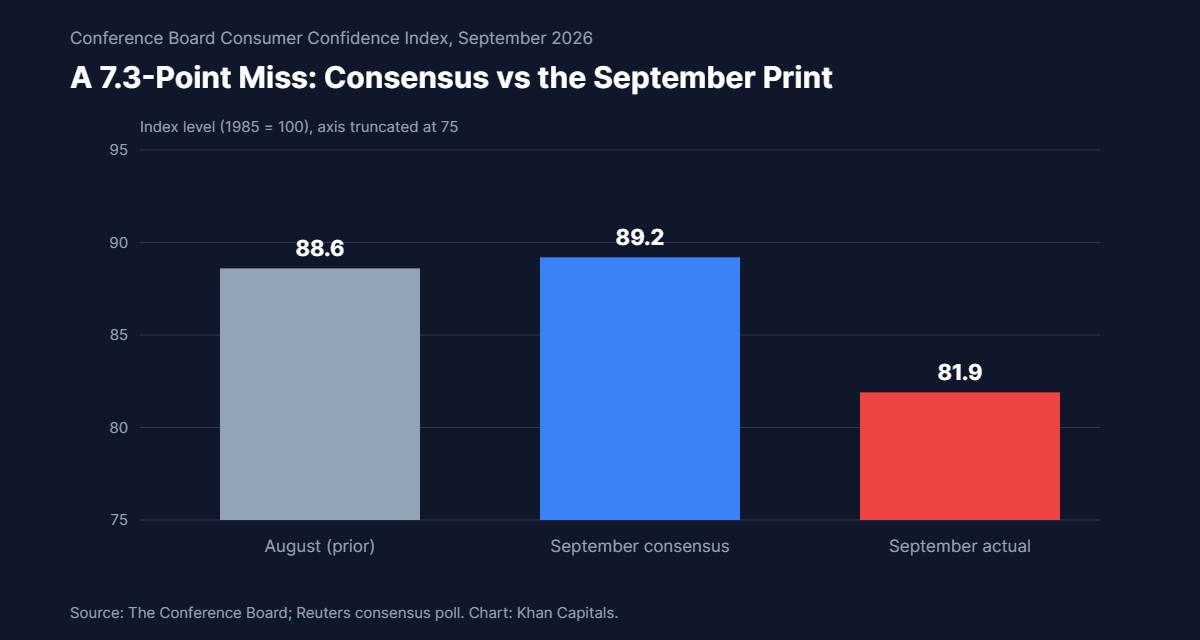
- US consumer confidence fell to 81.9 in September, down 6.7 points and the lowest reading since 2014, far below the 89.2 economists had forecast, according to the Conference Board.
- The forward-looking Expectations Index dropped to 63.6, its third consecutive monthly decline and far beneath the 80 threshold that has historically been associated with recession within a year.
- Prices did the damage: the Conference Board said references to prices, the cost of goods and services, and petrol in particular rose to new heights in September’s responses, reflecting the month’s surge in fuel costs.
- Net views of current business conditions turned negative for the first time since September 2024, while August job openings slipped to 7.1 million, an early sign the labour market is cooling alongside sentiment.
- The collision is the story: households are signalling recession two weeks after the Federal Reserve began raising rates into an oil-driven inflation shock, a combination that narrows the path between tightening too much and not enough.
Part of: Rates, Bonds & the Macro Picture — Khan Capital’s hub on the data and policy forces driving the global cycle.
The Household Sector Files a Dissent
Two weeks after the Federal Reserve delivered its first rate rise since 2023 and signalled more to come, the American household has filed its objection. US consumer confidence fell 6.7 points in September to 81.9, the weakest reading in more than twelve years and a 7.3-point miss against the 89.2 consensus. The number is striking on its own: it sits below anything recorded during the pandemic. What makes it market-moving is the composition beneath it, and the moment it arrives.
Equities took the print seriously. The S&P 500 fell on Tuesday as the data crossed, with the Dow losing 347 points and seven of eleven sectors closing lower, extending a two-day slide already under way on the back of rising Treasury yields. Confidence surveys rarely move markets in calm months. They move markets when they threaten to resolve an argument the market is already having, and the argument of autumn 2026 is whether the US economy can absorb dearer oil, dearer money and a trade war at the same time.
What Pushed US Consumer Confidence to 81.9
The Conference Board’s survey splits into two components, and both deteriorated. The Present Situation Index, which measures how consumers rate business and labour market conditions today, fell 7.9 points to 109.3. Within it, net views of current business conditions turned negative for the first time since September 2024. The Expectations Index, which captures the six-month outlook for income, business and jobs, fell 5.9 points to 63.6, its third consecutive decline.
| Measure (September 2026) | Reading | Change / context |
|---|---|---|
| Consumer Confidence Index | 81.9 | -6.7 points; lowest since 2014 |
| Consensus forecast (Reuters poll) | 89.2 | Miss of 7.3 points |
| Present Situation Index | 109.3 | -7.9 points |
| Expectations Index | 63.6 | -5.9 points; third straight decline; below the 80 recession marker |
| Job openings (August, JOLTS) | 7.1 million | Modest decline on the prior month |
The driver is not mysterious. Dana Peterson, the Conference Board’s chief economist, wrote that references to prices, the high cost of goods and services, and oil and petrol in particular rose to new heights in September’s write-in responses, reflecting the month’s surge in fuel costs. The petrol pump has become the single most visible price in the economy at exactly the moment the Gulf conflict has kept crude above $100 a barrel for much of the month. Households are not reading Federal Reserve communications; they are reading the forecourt sign, and the sign says inflation is back.
The 45-Point Gap Between Today and Tomorrow
The most analytically useful feature of the report is the distance between its two halves. Consumers rate the present at 109.3 and the future at 63.6, a gap of more than 45 points. That configuration, a still-tolerable today paired with a feared tomorrow, is the classic late-cycle signature. In the run-up to past downturns, the Present Situation Index has typically held up until the recession actually arrived, while the Expectations Index broke lower first. Households experience the economy in the present tense but make their spending decisions, particularly on durables, housing and travel, in the future tense. When the two series diverge this widely, deferred purchases follow.

The Conference Board itself notes that an Expectations reading below 80 has generally been associated with recession within the next year. That association deserves respect and scepticism in equal measure, which is what the historical record supplies.
Does the Recession Signal Actually Work?
The sub-80 Expectations threshold has an uneven record as a predictor, and the distinction between its true and false signals is instructive. The common thread is that the signal works when a broad squeeze on real incomes or credit is under way, and misfires when the gloom is about headlines rather than household cash flow.
| Episode of sub-80 Expectations | Backdrop | Recession within a year? |
|---|---|---|
| 2008 | Financial crisis, credit contraction | Yes (already under way) |
| 2011 | Debt-ceiling standoff, downgrade scare | No |
| 2022-2023 | Post-pandemic inflation shock, aggressive hikes | No; growth persisted |
| September 2026 | Oil shock, renewed hikes, tariffs | Open question |
The 2022-2023 episode is the bear case for the bears: expectations sat below 80 for long stretches while the economy grew, because nominal incomes were rising fast enough to carry real spending through the pessimism. The question for 2026 is whether that cushion still exists. Petrol at September’s prices is a direct tax on discretionary income; tariffs and counter-tariffs are pushing goods prices upward; and the labour market, per the JOLTS data, is loosening rather than tightening. The ingredients that made 2022’s false alarm false are visibly thinner this time.
From Saying to Spending: What Would Confirm the Signal
The standing objection to confidence data is that consumers routinely say one thing and spend another, and the objection is well earned: through most of 2022 and 2023, sentiment surveys described an economy that retail sales refused to deliver. The gap between the two has a name in the research literature, and a resolution: when confidence and spending diverge, it is usually spending that tells the truth about the next quarter, and confidence that tells the truth about the composition of it. Households under price pressure do not stop spending in aggregate; they trade down, defer the discretionary and rotate towards essentials, which shows up in company results long before it shows up in GDP.
That is why the hard-data calendar around this print matters more than the print itself. Confirmation of the pessimism would look like: retail sales decelerating with the weakness concentrated in durables and discretionary services; the personal savings rate rising as precaution overtakes consumption; consumer credit growth slowing while delinquencies on cards and motor loans keep climbing from already elevated levels; and airlines, restaurant groups and big-ticket retailers guiding down on volumes rather than prices. Refutation would look like September’s payrolls holding firm, real spending growing through the gloom as it did in 2022, and the confidence slump joining the long list of soft-data false alarms. The honest position is that the evidence now leans further towards confirmation than at any point in this cycle: the JOLTS decline, the turn in assessments of present business conditions and the petrol-led price complaints are all pointing the same way, and they are doing so at the same time.
The Fed’s Uncomfortable Mirror
For the Federal Reserve, the report is an unwelcome exhibit. The September hike was framed as insurance against an oil-led inflation psychology taking hold; the confidence data suggest that psychology has already taken hold, and that it is depressing sentiment rather than stoking demand. Households complaining about prices while cutting their expectations for income and business conditions describe a stagflationary mood, not an overheating one. That is precisely the configuration that makes central banking hardest: the inflation argues for the tightening the Fed has begun, while the sentiment argues that demand is closer to cracking than the activity data admit.
Markets still price a further quarter-point rise this year, consistent with the September dot plot’s median. The confidence print does not, on its own, change that arithmetic; the Fed under Kevin Warsh has been explicit that it weights realised inflation over survey sentiment. But it sharpens the trade-off. Every additional hike into a sub-82 confidence economy raises the odds that the 2027 story is about growth repair rather than inflation control. The bond market’s message and the household’s message are converging on the same warning from opposite directions: the long end worries about inflation and issuance, the consumer worries about being unable to keep up with either.
The S&P 500, which fell for a second session as the September confidence data crossed the tape.
Investor Implications
Equities. The immediate read-through is to the consumer discretionary complex: airlines, restaurants, big-ticket retail and housing-adjacent names are the sectors most exposed to a widening gap between present conditions and expectations, because that gap historically resolves through deferred purchases. Staples and off-price retailers have tended to be relative beneficiaries of trade-down behaviour in previous confidence slumps. At the index level, the print reinforces the pattern of recent weeks: a market held up by AI-linked capital spending while the household-facing economy softens beneath it, which is a recipe for continued narrow leadership rather than an immediate broad drawdown.
Fixed income. Confidence data cut both ways for bonds in an inflation shock. The growth signal argues for owning duration; the cause of the gloom, petrol prices, is the same force keeping the Fed hawkish and long yields rising. The near-term resolution runs through the data calendar: a soft September payrolls print alongside this confidence reading would give the rates market its first coherent slowdown narrative of the autumn, while a firm one leaves the long end to trade on supply and inflation alone.
Cross-asset. A sentiment slump driven by fuel costs keeps the oil-to-everything transmission at the centre of the macro picture. Energy prices are simultaneously lifting inflation expectations, dragging on discretionary spending and pushing policy tighter; any durable de-escalation in the Gulf would therefore ease three constraints at once, which is why crude remains the single most important price on any cross-asset screen.
What to Watch
- 30 September: the August personal consumption expenditures price index, the Fed’s preferred inflation gauge, which will show whether the price pressures households are reporting are broadening beyond energy.
- 2 October: the September employment report; a soft print would convert this confidence reading from an anecdote into the start of a slowdown narrative.
- 27-28 October: the Federal Reserve’s next policy meeting, where markets currently price a further quarter-point rise; the statement’s treatment of household demand will be scrutinised.
- Late October: the October Consumer Confidence release; a fourth consecutive decline in the Expectations Index would deepen the historical recession signal.
Conclusion
Confidence data are soft data until they harden into behaviour. September’s report does not prove a recession is coming; the 2022 episode showed how long American households can spend through their own pessimism. What it does establish is that the price shock has reached the kitchen table, that expectations have broken decisively below the level history associates with contraction, and that the Federal Reserve is now tightening into a consumer who already believes the worst. The margin for error on all sides, policy, corporate and household, narrowed this month. The data calendar of the next five days will decide which side the market chooses to believe.
Frequently Asked Questions
What is the Conference Board Consumer Confidence Index?
It is a monthly survey-based measure of how optimistic US households are about the economy. It combines a Present Situation Index, covering current business and labour market conditions, and an Expectations Index, covering the six-month outlook for income, business and jobs. September 2026’s headline reading of 81.9 was the lowest since 2014.
Why does an Expectations Index below 80 matter?
The Conference Board notes that readings below 80 on the Expectations Index have generally been associated with recession within the following year. The signal is imperfect: it preceded genuine contraction in 2008 but produced false alarms in 2011 and 2022-2023. September 2026’s reading of 63.6 sits well below the threshold after three consecutive monthly declines.
What caused consumer confidence to fall in September 2026?
The Conference Board reported that references to prices, the high cost of goods and services, and petrol in particular rose to new heights in survey responses, reflecting September’s surge in fuel costs. Views of current business conditions also turned net negative for the first time in two years, and job openings have been declining.
Does falling consumer confidence mean the stock market will fall?
Not mechanically. Confidence and equity returns are loosely linked in the short run, and markets have historically rallied through weak sentiment when incomes and earnings held up. The concern in 2026 is that the causes of the weakness, fuel costs, tariffs and tighter policy, also bear directly on corporate margins and consumer spending, so the same forces could weigh on both.
Sources: The Conference Board, US Consumer Confidence; Reuters via US News, “US consumer confidence dives to more than 12-year low in September”; Axios, “New 12-year low in consumer confidence”; Marketplace, “Consumer confidence falls to its lowest level in 12 years”; TheStreet, market reaction, 29 September 2026.
Related Reading: The confidence slump lands two weeks after the Fed’s first hike since 2023, and days after the 10-year Treasury yield’s break above 5 per cent. The petrol prices doing the damage trace back to the Saudi East-West pipeline attack, while the labour market backdrop was set out in the August jobs report. For the fundamentals, start with what actually defines a recession and how inflation works.

Leave a Reply