Khan Capitals | August 2026
Key Takeaways
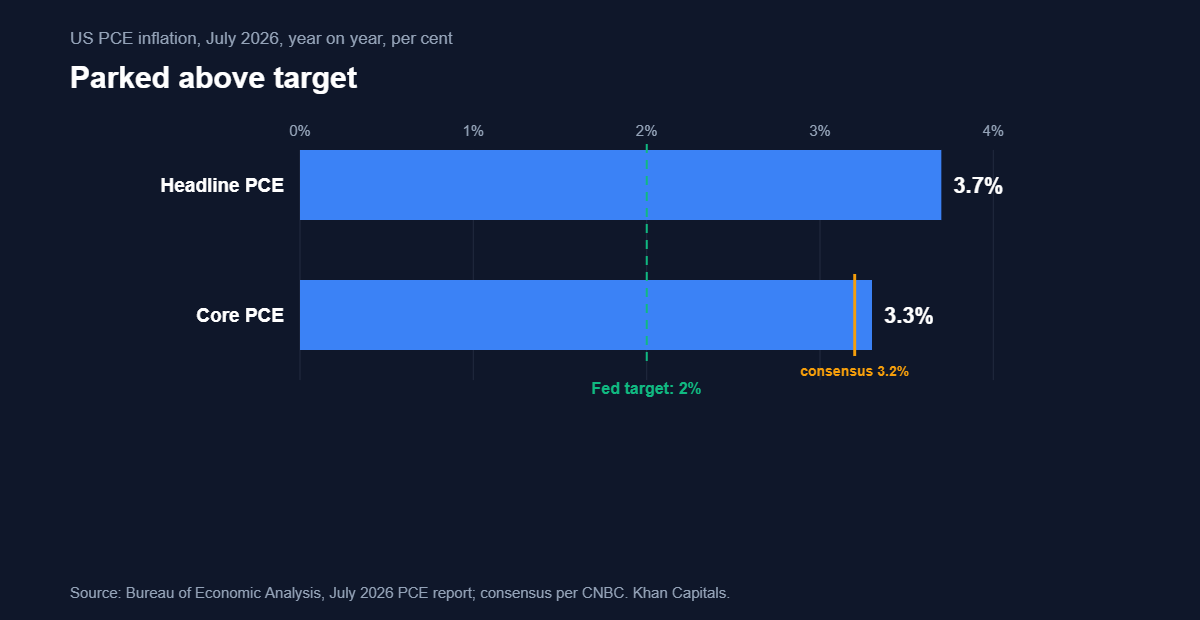
- The print came in hot. July PCE held at 3.7 per cent while core PCE rose 3.3 per cent against a 3.2 per cent consensus, unchanged from June and far above the 2 per cent target, with four months of data showing almost no net progress on the core rate.
- Warsh made it explicit. Hours later at Jackson Hole, the Federal Reserve chair said that if the committee cannot be confident underlying inflation is moving to target “clearly and at sufficient speed”, then “we have work to do”, his clearest signal yet that a Fed rate hike is on the table.
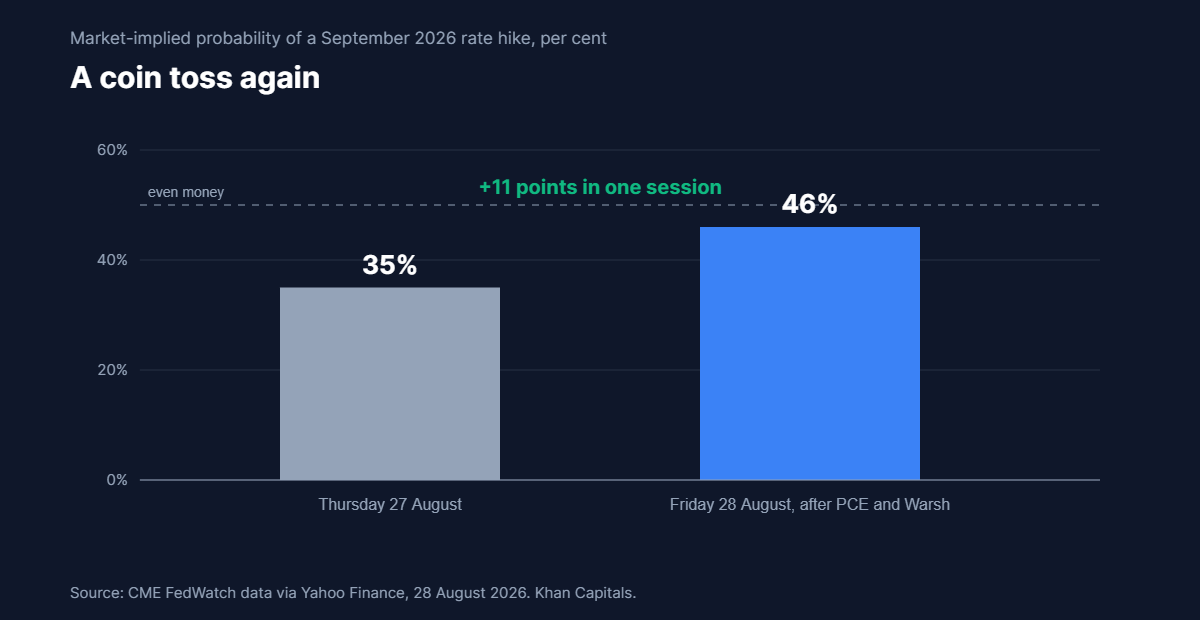
- The market repriced within hours. The probability of a September rate increase rose to 46 per cent from 35 per cent on Thursday, per CME data, and the two-year Treasury yield climbed 6.6 basis points to 4.29 per cent, a one-month high.
- The long end approved. While the two-year sold off, the 10-year yield was flat at 4.672 per cent and the 30-year fell 3 basis points to 5.16 per cent: a bear flattening that reads as the bond market rewarding hawkish credibility.
- Equities held. Stocks drifted rather than fell, taking the clarity as a fair trade for the hawkishness after a fortnight of guessing at the new chair’s reaction function.
Part of: The Fed’s Regime Change — Khan Capital’s hub on the Warsh Fed and the new policy era.
The Fed Rate Hike Returns to the Table
The case for a Fed rate hike was rebuilt in a single Friday. It arrived in two instalments: a morning inflation print showing the Federal Reserve’s preferred gauge stuck well above target, and a lunchtime keynote in which Kevin Warsh, giving his first Jackson Hole address as chair, told the audience precisely what the committee intends to do about it. By the close, the market-implied probability of a September rate increase stood at 46 per cent, up from 35 per cent a day earlier, and the two-year Treasury yield sat at a one-month high.
Sixteen days ago the story ran in the opposite direction. As we wrote in the Fed’s eight-day reversal, a tame July CPI five days after a payrolls contraction had halved September hike odds, and the debate was whether the tightening question was closed for the year. Friday reopened it. The round trip in expectations, closed to half-open to nearly even money, in barely a month, is the clearest measure of how little conviction the market has in its own Fed forecasts, and how much weight now rests on each individual data release.
What the July PCE Report Actually Said
The Bureau of Economic Analysis reported headline PCE inflation at 3.7 per cent for July, unchanged from June and slightly above forecasts. Core PCE, the series the Federal Reserve actually steers by, rose 3.3 per cent against a consensus of 3.2 per cent, also unchanged. The monthly core gain of 0.2 per cent was in line. Personal income rose 0.4 per cent and spending 0.2 per cent, both firmer than expected: a consumer still moving, an inflation rate not.
| July measure | Reported | Consensus | Prior month |
|---|---|---|---|
| Headline PCE (y/y) | 3.7% | Slightly below reported | 3.7% |
| Core PCE (y/y) | 3.3% | 3.2% | 3.3% |
| Core PCE (m/m) | 0.2% | 0.2% | n/a |
| Personal income (m/m) | 0.4% | Below reported | n/a |
| Personal spending (m/m) | 0.2% | Below reported | n/a |
The number that matters most is not in the table: it is the trend that is not there. Four months of core PCE data have produced almost no net improvement. The gauge eased from its May peak, flattered by falling energy prices, and then simply stopped. An inflation rate parked 1.3 percentage points above target, with income and spending still firm, is not a series drifting home on its own. That is the analytical foundation for everything Warsh said three hours later.
Warsh’s First Jackson Hole: The Sentence That Moved the Curve
Expectations for the keynote, as we set out in our preview of the speech, leaned toward studied neutrality: a new chair protecting optionality, with roughly seven in ten market participants expecting no clear signal. What was delivered was sharper. “While this summer’s PCE and CPI readings were better than expected, they do not tell me that underlying trends have meaningfully improved,” Warsh said, before the line the market traded on: “We must be confident that underlying inflation is moving to our objective, clearly and at sufficient speed. Otherwise, we have work to do. That’s our job, our mandate, and our charge to keep.”
Decoded, the message is a conditional tightening bias: the burden of proof has shifted from the case for hiking to the case for staying on hold. That inverts the framework the market had assumed since the 9-3 July hold with its triple hawkish dissent, in which the chair was cast as the restraining vote against a committee drifting hawkish. Friday suggested the chair may not need restraining at all. He is, on this evidence, closer to Hammack, Kashkari and Logan than the pause implied.
The immediate repricing was orderly but unambiguous. September hike odds rose eleven percentage points in a session. The two-year yield, the purest expression of near-term policy expectations, rose 6.6 basis points to 4.29 per cent. Equities, for their part, drifted higher into the close: after two weeks of guessing at the new chair’s reaction function, clarity itself carried a premium, even hawkish clarity.
The Tell in the Long End
The most informative price on Friday was the one that barely moved. While the front end sold off, the 10-year yield closed flat at 4.672 per cent and the 30-year fell 3 basis points to 5.16 per cent. The curve bear flattened: short rates up on hike risk, long rates steady to lower.
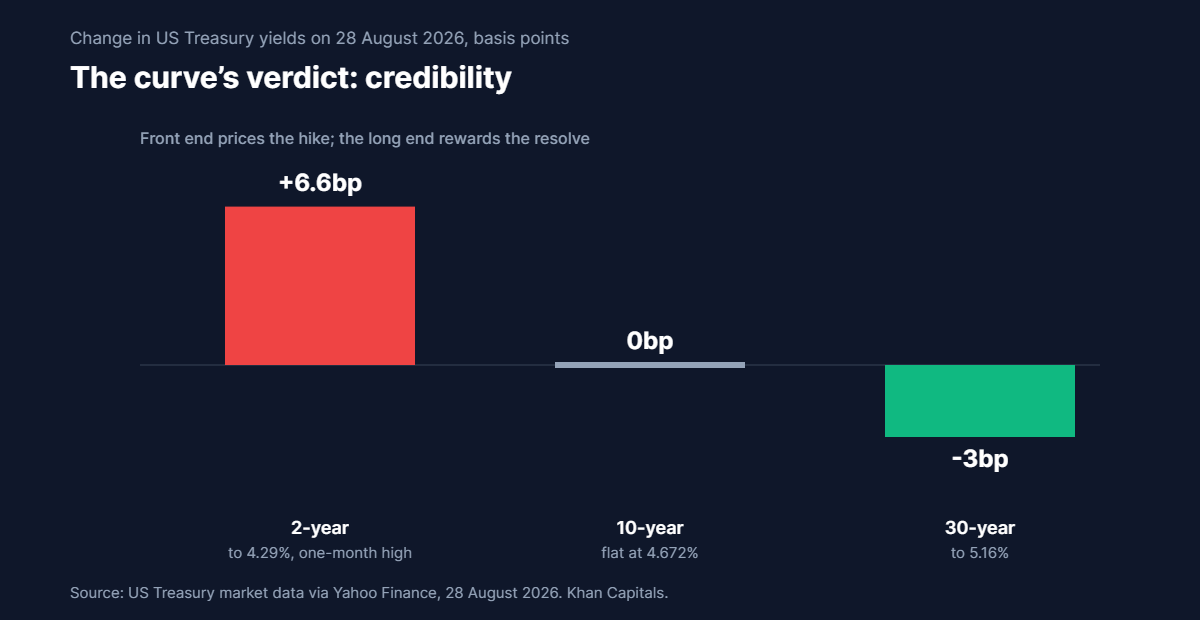
That shape is a verdict. Ten days ago, four sovereign bond markets were setting multidecade yield highs on a toxic blend of record deficits, heavy issuance and doubts about whether anyone in authority cared about the long end. A central bank chief signalling tighter policy is, mechanically, bad news for bonds; but for a long end worried about inflation tolerance, it is good news about the regime. Friday’s flattening says the bond market read Warsh’s hawkishness as credibility, not as recession risk: term premia have less to fear from a Fed willing to hike than from one talking itself into tolerance of 3.3 per cent core inflation. It is the same logic that made the Treasury’s buyback intervention a palliative rather than a cure: the long end does not want to be bought, it wants to be convinced.
A Committee, Not a Chairman
The September decision now turns on committee arithmetic rather than chair rhetoric. July’s vote already produced three dissents in favour of a hike, the most hawkish minority in a decade. If Warsh has genuinely moved toward that camp, the question becomes who else follows, and whether the doves who backed the hold can absorb another month of stalled core inflation without conceding. The market’s 46 per cent is, in effect, a coin toss weighted by two data points still to come: the August employment report and the August CPI, both landing before the meeting.
What makes the setup unusual is the growth backdrop. This is not a committee tightening into strength: payrolls printed negative in early August for the first time in 53 months, retail sales fell, and the consumer is visibly narrowing. Warsh himself noted the economy “appears to have strengthened” over the summer, a characterisation the activity data only partially supports. A hike delivered into softening employment would be a pure inflation-credibility trade, accepting growth risk to re-anchor expectations. That is the hardest version of the trade-off, and the one the next three weeks of data will either force or dissolve.
| Path into 16 September | What it needs | Likely market expression |
|---|---|---|
| Hike (market: ~46%) | Firm August CPI; employment stabilising; dissenters plus chair carry the vote | Front end sells off further; flattening extends; rate-sensitive equities lag |
| Hawkish hold | Mixed data; committee waits but keeps the bias | Odds roll to the October and December meetings; two-year stays pinned near highs |
| Dovish relief | Soft August CPI and weak payrolls; core finally turns | Front end rallies; the August repricing unwinds for a third time |
The Credibility Trade Beyond Bonds
The repricing did not stop at the Treasury curve. The dollar firmed on the higher rate path, and gold, which spent the week setting records near $4,700 an ounce on a mix of central bank buying, a $40 trillion national debt and quiet doubts about inflation tolerance, now faces a more complicated backdrop. Gold’s 2026 rally has been, in part, a bet against exactly the resolve Warsh displayed on Friday; a Fed that hikes against 3.3 per cent core inflation is a Fed that weakens the debasement thesis at the margin. That the metal held near its highs anyway tells you how much of the bid is structural, from official-sector buyers who are not trading the FOMC calendar at all.
There is a fiscal reading, too. A credible inflation-fighting Fed lowers the long-term cost of servicing the federal debt by containing term premia, which is worth more to the Treasury than any buyback schedule. In that sense, Friday’s bear flattening did more for the long end in an afternoon than the doubling of buyback operations announced earlier in the week. Credibility is the cheapest form of yield-curve control, and it is the one tool that does not appear on any balance sheet.
Investor Implications
Equities. The equity market’s calm on Friday rests on a specific belief: that a hike, if it comes, would be a one-off credibility exercise rather than the start of a cycle. That belief is testable and fragile. Rate-sensitive segments, small caps, housing-linked names and long-duration growth, carry the most exposure to the front end repricing further, while the AI complex enters the window with the strongest earnings cover, as this week’s Nvidia print demonstrated. The pattern of the past month, in which every macro repricing was absorbed sector by sector rather than at the index level, likely continues.
Fixed income. The front end is now a data-release trade with binary risk into 16 September; the more interesting position is further out. Friday’s bear flattening suggests long-end investors will tolerate, even welcome, near-term tightening, which caps the term-premium spiral scenario that drove August’s selloff. The two-year at 4.29 per cent prices half a hike; it does not price a cycle. The gap between those two things is where the volatility lives.
Cross-asset. A dollar supported by hike risk, gold at records on debt and credibility worries, and equities at highs on AI earnings is not a stable constellation; at least one of those trades is wrong about the next six months. The sequencing of August employment data, August CPI and the FOMC will decide which. Non-advice framing applies throughout: these are scenario mechanics, not recommendations.
What to Watch
- 4 September 2026: the August US employment report; a second negative payrolls print would collide head-on with the hike case.
- 9 September 2026: the Treasury’s first upsized buyback operation, the other prong of official support for the long end.
- Mid-September 2026: August CPI, the final inflation reading before the decision.
- 16 September 2026: the FOMC decision and press conference; watch the vote split as closely as the outcome.
Conclusion
Friday compressed the whole 2026 monetary policy debate into one session: an inflation gauge that has stopped improving, a new chair who told markets plainly that this is not acceptable, a front end that repriced toward tightening, and a long end that quietly applauded. The Fed rate hike question that August opened, closed and reopened is now scheduled for resolution on 16 September, with two data releases standing between here and there. What changed at Jackson Hole is not the odds, which remain a coin toss, but the reaction function: the burden of proof has moved to the case for doing nothing. Markets can trade a hawk and they can trade a dove; what they could not trade was a cipher, and as of Friday, Kevin Warsh is no longer one.
Frequently Asked Questions
What did the July 2026 PCE report show?
Headline PCE inflation held at 3.7 per cent year on year in July, while core PCE rose 3.3 per cent against a consensus of 3.2 per cent, unchanged from June. Personal income rose 0.4 per cent and spending 0.2 per cent, both firmer than expected. Core inflation has shown almost no net improvement for four months.
What did Kevin Warsh say at Jackson Hole 2026?
In his first Jackson Hole keynote as Federal Reserve chair, Warsh said this summer’s better inflation readings “do not tell me that underlying trends have meaningfully improved”, and that unless the Fed can be confident inflation is returning to target “clearly and at sufficient speed”, then “we have work to do”. Markets read this as a signal that a rate hike is under genuine consideration.
Will the Fed raise interest rates in September 2026?
Market pricing on 28 August put the probability of a September hike at 46 per cent, up from 35 per cent a day earlier, per CME data. The decision on 16 September will likely turn on the August employment report and the August CPI, both released before the meeting. It is an open question, not a settled one.
Why did long-term Treasury yields fall on a hawkish speech?
The two-year yield rose 6.6 basis points while the 30-year fell 3 basis points, a bear flattening. Long-dated bonds are priced off inflation expectations and credibility as much as policy rates, so a central bank willing to tighten against stubborn inflation can lower long-term yields even as it raises short-term ones.
Sources: CNBC, core PCE at 3.3 per cent in July; CBS News, July PCE report; Bureau of Economic Analysis, core PCE price index; Yahoo Finance, rate-hike expectations rise on Warsh speech; CNBC, Warsh sharpens inflation warning at Jackson Hole; PBS News, Warsh’s Jackson Hole speech.
Related Reading: The setup for the keynote is in our Jackson Hole preview, and the first leg of the odds round trip in the Fed’s eight-day reversal. The committee’s hawkish minority was mapped in the triple dissent, and the long end’s summer revolt in the global bond selloff. For the fundamentals, start with how Fed rate odds work and inflation, explained. The strong August payrolls print that followed is covered in our August jobs report analysis. A fresh supply-side shock has since joined the debate; see the US-Canada tariff escalation. The fiscal side of the squeeze is covered in the Treasury’s $6 billion buyback escalation. Frankfurt moved first; see the ECB’s September hike to 2.5 per cent. The question was settled a month later in the Fed rate hike of September 2026.

Leave a Reply